
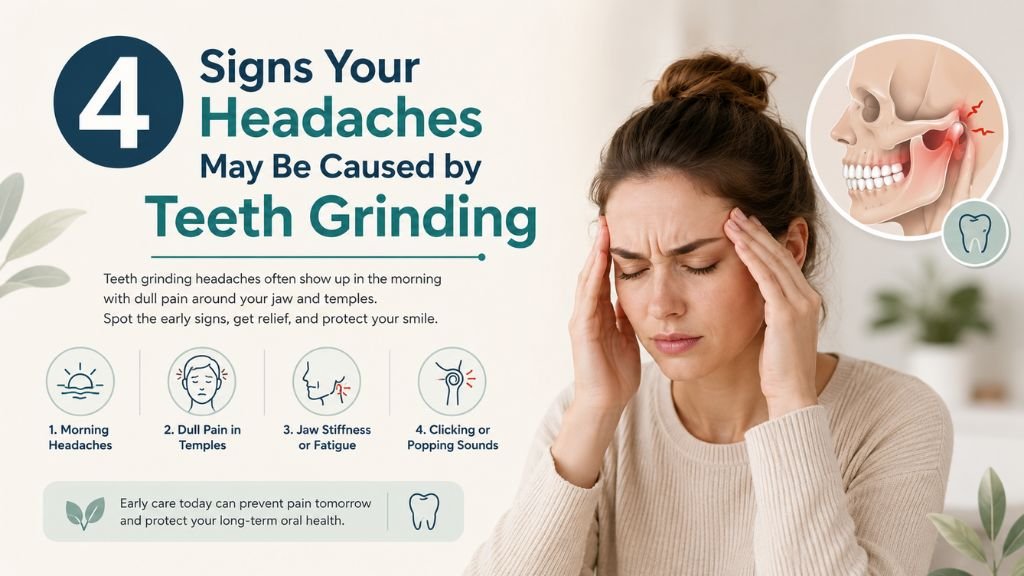
Teeth grinding headaches are characterised by a dull, persistent pain around your jaw and temple. Originating from bruxism, teeth grinding headaches are most noticeable when you first wake up and are accompanied by stiffness and movement noises.
In this article we discuss 4 early signs of teeth grinding and try to identify if emergency dental care is required.
How Do Teeth Grinding Headaches Differ from Other Types?
Because head pain can stem from numerous sources, it is essential to look how headache from bruxism differs from others.
| Type | Pain Characteristics | Key Distinguishing Factors |
| Tension Headache | Mild to moderate steady ache that feels like a tight band. | Frequently builds up as the day goes on. Often triggered by desk work, stress, or neck strain. |
| Sinus Headache | Deep, constant pressure around the cheekbones, eyes, head and nose. | Typically occurs alongside nasal congestion and hay fever. It severely hampers your functioning and cognition. |
| Migraine Headache | Intense, throbbing, or pulsating pain isolated to one side of the head. | Accompanied by systemic symptoms such as sensitivity to light. |
| Bruxism Headache | Dull, steady aching pressure concentrated in both temples or across the forehead. | Most noticeable upon waking and improves after a few hours once the jaw relaxes. |
4 Early Signs Your Headaches Stem from Teeth Grinding
1. Distinct Morning Onset
This occurs because your jaw muscles have been contracting under immense subconscious force for hours during sleep, leaving them exhausted by dawn.
2. Dull Aching Concentrated in the Temples
The pain from bruxism is generally characterised by a localised, steady, radiating pressure rather than a sharp or throbbing sensation. It specifically targets the temporalis muscles where you feel a tight, heavy band squeezing across your forehead.
3. Jaw Stiffness and Facial Fatigue
The masseter muscles in your cheeks feel tender to the touch and you might experience limited mouth opening span.
4. Clicking, Popping, or Grating Joint Sounds
Chronic clenching places intense structural strain on the temporomandibular joints located just in front of your ears. You may notice distinct clicking or popping sounds when you open your mouth to speak or chew.
How to Confirm the Early Signs Of Teeth Grinding
At our St Clair dental clinic, when we examine patients experiencing chronic facial pain, a detailed assessment translates these markers into a clear, effective treatment plan.
- Chronic grinding leaves unmistakable flat, shiny patches on the biting surfaces of your teeth, known as wear facets.
- Micro-fractures in enamel.
- Raised white line along the inner cheeks or a scalloped pattern along the edges of the tongue.
- The masseter and temporalis muscles reflect tenderness or overdevelopment.
Which Nutritional and Lifestyle Aspects Affect Bruxism?
Nutritional Aspects Leading To Early Signs Of Teeth Grinding
What you consume directly affects muscle function and the quality of your sleep, both core components of teeth grinding.
- Magnesium: Helps regulate muscle contractions and calm the nervous system. Its deficiency can cause muscles to cramp or spasm more easily.
- Caffeine: A central nervous system stimulant that increases general muscle alertness and tension. Consuming coffee, energy drinks, colas, or chocolates, particularly in the afternoon and evening, elevates nighttime jaw activity and increases grinding intensity.
- Alcohol: Severely disrupts your deep sleep patterns and increases the frequency of microarousals, brief subconscious awakenings during the night. When patients discuss it at our St Clair dental clinic, we often observe that bruxism is triggered during these exact moments.
- Hydration Levels: Dehydration makes your muscles much more susceptible to tightness and involuntary cramping. Drinking an adequate amount of water throughout the day helps keep muscle tissues functioning optimally and reduces the likelihood of nocturnal spasms.
Lifestyle Aspects Leading To Early Signs Of Teeth Grinding
Bruxism is frequently a physical manifestation of internal stress and sleep architecture issues.
- Stress Management and Cortisol Reduction: High levels of emotional or psychological stress, trigger a physical fight-or-flight response that results in a clenched jaw. Engaging in mindfulness, deep breathing exercises, or reading before sleep, lowers cortisol levels and calms muscle activity.
- Physical Activity Timing: Performing intense workouts late in the evening can overstimulate your nervous system. It is best to complete heavy exercise at least four hours before you sleep.
- Sleep Environment Hygiene: Since sleep grinding is associated with sleep stages, creating a dark, quiet, and cool environment helps.
Home Remedies For Bruxism and Teeth Grinding Headaches
Individual efforts can help break the cycle of chronic tension and pain through these:
Resting Your Face
- Train yourself to monitor your jaw periodically during the day.
- The ideal resting posture for your mouth is to have your lips gently closed, with your upper and lower teeth slightly apart.
- Your tongue should rest lightly against the roof of your mouth, just behind your front teeth.
Targeted Relaxation Exercise
- Open your mouth comfortably wide while keeping the tip of your tongue pressed against the roof of your mouth.
- Hold this position for five seconds, then slowly relax.
- Repeating this exercise several times a day helps stretch the masseter muscles and reduces subconscious daytime clenching.
Gentle Heat Therapy
- Apply a reasonably warm and damp towel to the sides of your face for ten minutes before bed.
- This gentle heat increases blood flow to the area, relaxes tight muscle fibres, and prepares your jaw for deep rest.
Professional Remedies For Bruxism and Teeth Grinding Headaches
Sometimes, the general remedies prove to be ineffective. In such cases, professional measures can alleviate muscle strain much more effectively.
Custom-Made Occlusal Splints
- A primary measure in which a precise digital scan or a physical mould of your teeth is used to create a hard acrylic night guard.
- Unlike OTC mouthguards, a custom hard splint is meticulously adjusted to balance your bite.
- It absorbs the grinding forces, prevents the upper and lower teeth from locking together, and keeps the jaw in a neutral position.
Restorative Reconstruction
- After years of grinding, your jaw may close farther than normal, reducing the lower face height and overworking the facial muscles.
- In this case, Your Healthy Smile Dentists can use porcelain crowns, onlays, or composite bonding to rebuild your teeth to their original shape and height.
- We also help you restore proper jaw alignment and relieve the strained muscles that trigger headaches.
Orthodontic Correction
- When misaligned teeth are the root cause of teeth grinding, orthodontic treatment can be considered.
- Using braces or clear aligners balances the chewing forces, eliminating the specific areas that cause the jaw to clench subconsciously.
Coordinated Intervention
- Severe sleep grinding is frequently tied to broader systemic issues.
- This is where Your Healthy Smile Dentists identify signs of sleep apnoea, such as an enlarged tongue or a narrow airway.
- In these cases, we collaborate with sleep physicians for combined efforts on further measures.
Smile & Sleep Better
At home, incorporating magnesium-rich foods such as spinach, pumpkin seeds, almonds and dark chocolate can help you with teeth grinding. Further, lifestyle management and limiting alcohol consumption also helps to reduce teeth grinding instances.
But if the headache still persists, Your Healthy Smile Dentists at St Clair are here to help you. We identify and address the early signs of teeth grinding to prevent emergency dental care that can arise out of it.
Meet Your Healthy Smile Dentists at 154 Bennett Rd, St. Clair for a relief that makes your day feel better.
FAQs
1. Can the early signs of teeth grinding be detected before a severe headache begins?
Yes. The early signs of teeth grinding include waking up with a stiff or tired jaw, noticing unexplained sensitivity in your teeth when drinking cold liquids, and hearing clicking or popping sounds in your jaw joints when chewing breakfast.
2. Can chronic teeth grinding trigger migraine episodes?
Teeth grinding does not directly cause migraines, which are complex neurological events involving changes in blood vessels in the brain. However, the intense, continuous muscle strain and the irritation of the trigeminal nerve system caused by severe clenching can act as a significant trigger, making migraine episodes more frequent or severe.
3. What happens when someone has periodontitis and bruxism?
When periodontitis has already initiated bone loss around a tooth, teeth grinding causes secondary occlusal trauma. This combination leads to increased tooth mobility, much deeper gum pockets, and severe tissue recession far more quickly than gum disease alone. Read our blog on periodontitis (hole in gum) to learn more on it.
Reviewed By Dr. Lekha Menon