
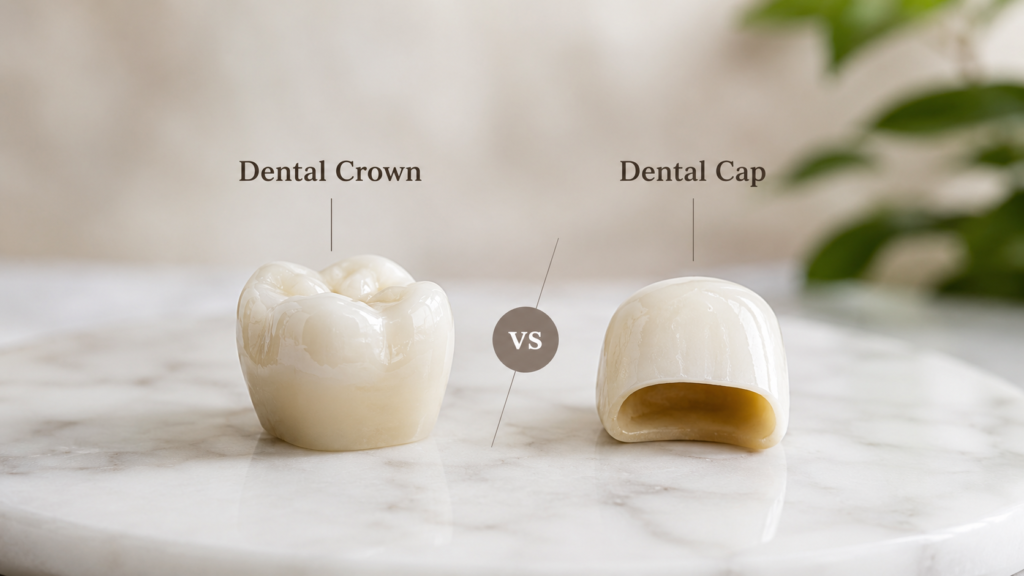
When a tooth is damaged by decay, fractures, or wear, a protective restoration is often necessary to maintain oral function. However, the terminology used in consultations can be confusing for many patients. This guide provides an objective look at modern restorative options, materials, and financial considerations involved.
Dental Crown vs Cap, Is There a Difference?
In modern dentistry, the terms are functionally synonymous.
- The word cap is a traditional term that many patients use to describe the process of covering a tooth.
- Within a professional environment, the preferred clinical term is dental crown.
Both terms refer to a customised prosthetic that is bonded over your natural tooth structure.
When Do Patients Compare Dental Crown vs Cap
Crown placement is indicated in specific clinical circumstances, determined through examination, dental history, and X-ray assessment.
A dental crown may be recommended in the following situations:
- Significantly compromised tooth structure as the extent of damage or decay is beyond what a direct restoration can reliably address long-term.
- Post-endodontic treatment (root canal therapy) considers teeth that have undergone root canal treatment become structurally more susceptible to fracture; a crown is commonly placed to protect the remaining tooth structure.
- Fractured or cracked cusps (tooth tips) is where a portion of the biting surface has been lost or is at risk of further fracture.
- Large or failing restorations — particularly where an existing filling has compromised the surrounding tooth walls, reducing structural integrity.
- Bridge construction — crowns serve as retainers on adjacent teeth to support a fixed dental bridge replacing a missing tooth.
- Significant morphological or aesthetic concerns — in cases where veneers or other conservative options are not clinically suitable.
Each patient’s condition is unique. After clarifying the distinction between dental crowns vs caps, the most appropriate treatment is determined following a thorough clinical assessment.
The Dental Cap vs Crown Treatment Process
Crown placement is generally completed over two clinical appointments. At Your Healthy Smile, a digital intraoral scanner is used as part of the workflow, which may reduce the need for conventional impression materials for suitable cases.
First Appointment — Tooth Preparation:
- Local anesthesia is administered to manage patient comfort during the procedure
- The tooth is carefully prepared to create adequate space for the crown restoration
- A digital scan or physical impression is recorded and forwarded to a dental laboratory for crown fabrication
- A provisional crown is placed to protect the prepared tooth and maintain function between appointments
Second Appointment — Crown Placement:
- The provisional crown is removed and the prepared tooth is cleaned.
- The permanent crown is assessed for accuracy at the gumline, bite accuracy, and shade compatibility with adjacent teeth.
- Any necessary clinical adjustments are made prior to permanent cementation.
- The patient’s bite is verified following cementation.
The interval between appointments is typically two to three weeks, subject to laboratory turnaround.
Dental Crown Material Options Available in Australia
The material selected for a dental crown influences its aesthetics (appearance), durability, and clinical suitability.
Your primary options available may include:
- Porcelain-fused-to-metal (PFM) is a metal alloy substructure bonded with a ceramic (porcelain) overlay. This is a long-established option that balances strength with aesthetics, though a visible metal margin at the gumline may develop over time.
- All-ceramic / all-porcelain contains no metal; it is designed to closely match the appearance of natural dentition (teeth). In the past, all-ceramic materials were reserved for anterior (front) teeth, though advances in material science now support their use in posterior (back) regions.
- Zirconia is a high-strength ceramic material (zirconium dioxide) that offers both aesthetic qualities and mechanical durability; it is increasingly used for both anterior and posterior restorations.
- Full cast metal is selected for its longevity and low wear on opposing teeth; occasionally indicated for posterior teeth in patients with bruxism or habitual tooth grinding, and where aesthetics are a secondary consideration.
Your Healthy Smile Dentists can advise on the most appropriate material based on the tooth’s location, occlusal load, and individual patient factors.
Comparing Dental Crown with Other Treatments
Patients are sometimes uncertain about the distinction between a crown, a dental veneer, an inlay, or an onlay at our St Clair dental clinic. Your Healthy Smile Dentists explain to them that each restoration addresses a different scope of damage and involves a different degree of tooth preparation.
| Restoration | Area of Coverage | Degree of Tooth Preparation | Primary Application |
| Dental Crown (Cap) | Full circumferential coverage above the gumline | Significant reduction of tooth structure (approximately 1–2 mm on all surfaces) | Used for structurally compromised, root-canal-treated, or heavily restored teeth requiring full protection |
| Dental Veneer | Facial surface only | Minimal preparation — typically around 0.5 mm of enamel removal | Best suited for anterior teeth with cosmetic concerns where the underlying tooth remains structurally sound |
| Dental Inlays | Internal chewing surface; does not extend over cusps | Conservative preparation involving removal of decayed or failing material only | Recommended for moderate cavities where a direct filling is insufficient but cusp coverage is unnecessary |
| Dental Onlays | Occlusal surface plus one or more cusps | Moderate tooth preparation | Ideal for larger cavities or fractured cusps, offering a middle ground between an inlay and a full dental crown |
Evaluate if You Need One
Our article discussed various aspects of dental crown, the terminology of dental crown vs cap, and also compared it with other options. However, we understand that an individual might have many more questions beyond this.
This is where a consultation from Your Healthy Smile Dentists at St Clair can be highly insightful. This is where we answer your questions regarding dental crown cost Australia offers you.
Find Your Healthy Smile Dentists at 154 Bennett Rd, St. Clair where we help you clear all your doubts with our experience of four decades.
FAQs
Q1. Is there a clinical difference between a dental crown vs cap?
In modern dentistry, these terms describe the same protective restoration. A cap is a traditional term for the way a prosthetic sits over a tooth. A crown is the official clinical term used to describe a custom-made cover that restores a tooth to its natural shape and strength.
Q2. Does the procedure for a dental crown vs cap hurt?
No, the process is designed to be comfortable. The dentist uses a local anaesthetic to numb the tooth and surrounding gums. You may feel some mild pressure, but you should not feel any sharp pain during the treatment.
Q3. Will my restoration look like a natural tooth?
Yes, modern restorations are colour-matched to your surrounding teeth. Highly skilled technicians ensure the shade and texture blend seamlessly with your natural smile.
Q4. Is a temporary cover necessary while waiting for the final result?
Yes, a temporary cover protects the shaped tooth from sensitivity and prevents it from shifting while the laboratory crafts your permanent restoration.
Q5. Can I get braces if I already have a dental cap vs crown?
Yes, orthodontic treatment is still possible. However, the brackets for traditional braces may require a special adhesive to bond to the crown’s ceramic surface.
Q6. How long do these restorations typically last?
With excellent oral hygiene, a high-quality restoration can last between ten and twenty years. Some materials, like gold or high-strength zirconia, can last even longer if you avoid habits like tooth grinding.
Q7. How do I maintain my restoration at home?
Maintain a regular routine of brushing twice a day and flossing once a day. Using interdental brushes can be very helpful for cleaning the area around the base of the restoration.
Reviewed By Dr. Lekha Menon