
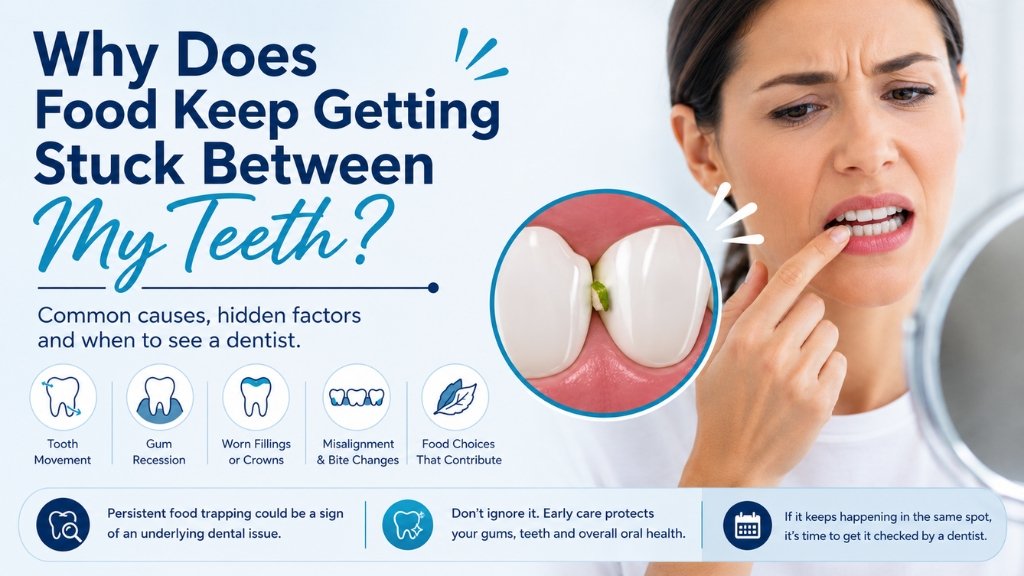
When you find food stuck between teeth frequently, it becomes more than an annoyance, it raises questions. The most common reasons are small spacing changes, gum recession, tooth movement, choice of food or a filling that is no longer shaped quite right. But are there any hidden reasons that lead to food stuck between teeth? Your Healthy Smile Dentists reveal it all by answering the questions we often get asked at our St Clair dental clinic.
What is food impaction?
Food impaction is the forceful wedging of food debris into the spaces between teeth during chewing. It typically occurs when natural tooth contacts are loose or open.
This mechanical pressure drives particles deep into the gum tissue, causing inflammation, bacterial fermentation, localised discomfort and an increased risk of dental decay.
Common reasons behind finding food stuck between teeth
- Loss of Contact: Teeth should ideally press firmly against each other. However, over time, teeth can shift due to age, wear, or the loss of a tooth elsewhere in the mouth.
- Gum Recession: Healthy gums fill the triangular spaces between the bases of your teeth. If the gums recede due to aging, aggressive brushing, or gum disease, this protective layer disappears.
- Worn or Damaged Dental Work: If an old filling chips or a crown was not contoured perfectly to fit against the neighbouring tooth, it creates an ideal space for food accumulation. This is why getting your dental treatments done from an experienced dentist matters.
- Misalignment: Crowded or rotated teeth create angles that our toothbrush bristles and natural saliva cannot easily clean. In this case, food particles go unnoticed despite following proper oral hygiene practices.
Does choice of food contribute to it?
You may find food stuck between your teeth with certain items more frequently than others. This includes:
- Fibrous foods: Raw vegetables, spinach, and stringy meats possess long, resilient fibres that glide into tight spaces and resist being dislodged by natural tongue movement.
- Small and rigid foods: Popcorn hulls, sesame seeds, and crushed nuts are notoriously difficult to clear because of their hard and irregular shapes.
- Sticky foods: Bread, crackers, and doughy biscuits form a dense, pasty consistency when chewed, stick to dental surfaces, and pack into gaps with each bite.
The key sign to observe here is that it keeps happening in the same spot.
Could my gums be the reason for having food stuck between teeth?
Yes. Gum recession and gum disease can make food trapping more pronounced.
As gums shrink back, the spaces near the tooth neck open up and food can pack more easily into those areas. This matters because the gap may not be obvious at first.
A person can think they are dealing with poor brushing and flossing habits when the real issue is the support around the tooth. However, gum disease can also lead to bleeding, tenderness, bad breath, and looser teeth, all of which can make food stuck between teeth a recurring problem.
Your Healthy Smile Dentists’ Insights: At our St Clair dental clinic, we often look for gum inflammation, recession, or early periodontal changes in such cases.
Do fillings, crowns, or bite changes cause food to be trapped more?
Yes. A filling, crown, or bite change can contribute to food impaction.
Dental restorations need to accurately recreate the natural tooth shape and contact points. If a filling is slightly overcontoured, undercontoured, or open at the contact point, food can wedge into the space.
Also, bite alignment matters here because if teeth crowd, drift, or no longer meet evenly, pressure during chewing can push food into one area. Studies also point to faulty restorations, open contacts, and altered contour as common causes.
What hidden factors can make it worse?
Beyond the shape of the teeth and the type of meal, several underlying biological and behavioural elements influence how debris accumulates.
Factors that we often diagnose at our St Clair dental clinic include:
- Saliva Production and Volume: If an individual experiences dry mouth, food remnants are not washed away. Instead, particles stick to the enamel and become packed into tight spaces.
- Chronic Teeth Grinding or Clenching: Formally called bruxism, this habit usually occurs during sleep. The intense pressure forces teeth to flex and shift microscopically. Over time, this micro-movement weakens the tight seals between teeth, allowing gaps to open under chewing pressure.
- Mouth Breathing: Breathing consistently through the mouth rather than the nose dries out the oral tissues. This lack of moisture makes food debris significantly more adhesive.
- Aggressive Toothpick Habits: Using wooden toothpicks incorrectly can cause more harm than we anticipate. Once this tissue, known as the interdental papilla, is flattened or damaged, it creates a permanent trap.
- Prescription Medications: Medications for blood pressure, allergies, and anxiety list dry mouth as a primary side effect.
- Subtle Changes in Bone Density: Even a fraction of a millimetre of movement in the jawbone can destabilise the alignment of the dental arch.
Consequently, changes in saliva flow and additional factors not only allow food to remain trapped but also accelerate the rate of decay.
When should you see a dentist about this?
Food getting stuck between your teeth now and then is common, but food getting stuck in the same spot after every meal must be examined by a professional.
Book an appointment if:
- Food traps consistently in the same location after meals.
- You notice bleeding when flossing or eating.
- The area feels tender, swollen or sensitive to temperature.
- You can see a visible gap, dark patch or roughness between teeth.
- Your last professional dental check-up and clean was more than six months ago.
If any of the above are relevant in your case, call (02) 9670 6991 or visit us at 154 Bennett Rd, St. Clair by searching on your devices for a ‘dentist near me’.
FAQs
Q1. Can a missing tooth cause other teeth to collect food?
Yes, when a tooth is lost, the neighbouring teeth lose horizontal support and slowly tilt or drift into the space left by the missing tooth. This shifting compromises the tight contacts throughout the entire dental arch, creating entirely new gaps.
Q2. Can braces or clear aligners help with food stuck between teeth?
Yes, orthodontic treatments physically move teeth into their ideal positions, closing open contacts and straightening overlapping areas. This eliminates the awkward angles that naturally serve as collection zones for meals.
Q3. Why does food get trapped under a temporary crown?
Temporary crowns are fabricated from acrylic materials that do not fit as precisely as final porcelain crowns. Because they are designed to be easily removed at a later appointment, their margins and contacts are less tight, making them more prone to temporarily catching debris.
Q4. Can using toothpicks harm my teeth?
Yes, frequent and aggressive use of rigid toothpicks can blunt and destroy the delicate triangular gum tissue between teeth. Once this tissue is lost, an empty space remains, which permanently invites more debris to accumulate.
Reviewed By Dr. Lekha Menon