
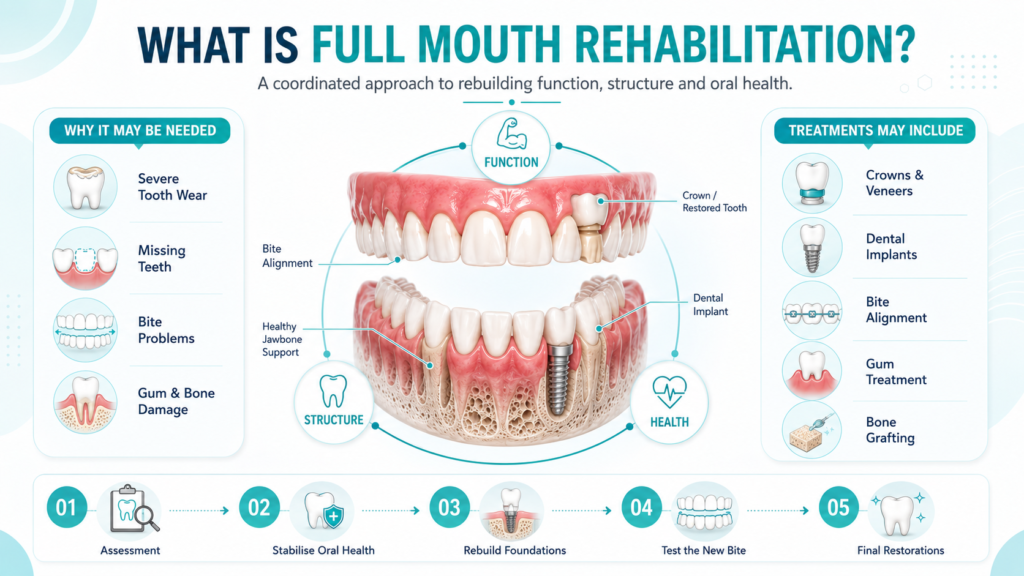
Full mouth rehabilitation, frequently referred to as full-mouth reconstruction or restoration, is a comprehensive dental treatment that restores the function, structure, and health of all your teeth. It can help you resolve issues like severe wear, misalignment, and decay.
In this article, Your Healthy Smile Dentists will help you find answers to what is full mouth rehabilitation, its suitability, and who should be more careful when considering it.
What is Full Mouth Rehabilitation?
To properly answer the question, we must look well beyond basic cosmetic enhancements.
Full mouth rehabilitation is a highly customisable sequence of treatments aimed at fully restoring the health, mechanics, and physical appearance of all your teeth in both the upper and lower arches.
This comprehensive process combines multiple specialities, including restorative therapies, jaw alignment corrections, and advanced periodontal care to establish a stable, highly durable oral foundation that functions comfortably.
And because it avoids approaching dental issues in isolation, searching for a qualified ‘orthodontic near me’ can be the very first instinct.
Who Needs this Comprehensive Treatment?
This restorative procedure is ideal for patients suffering from systemic dental breakdown.
Consider a case at our St Clair dental clinic where the patient suffered from chronic teeth grinding that reduced their tooth’s structure and elevated sensitivity. This caused constant headaches originating in their jaw and limited chewing ability, requiring a total bite reconstruction.
This example helps us learn that:
- Patients dealing with severe bruxism (chronic teeth grinding) often flatten their teeth over several decades, causing a collapsed bite.
- Others experience advanced periodontitis (severe gum infection) that weakens the vital bone support, leading to partial edentulism or extensive tooth loss.
- Structural issues like severe malocclusion (improperly aligned bite) can cause ongoing stress to the delicate jaw joints.
- Additionally, victims of major facial trauma or individuals with acid erosion often require a full mouth rehabilitation.
In conclusion, oral issues can compromise your ability to chew food, speak clearly, or live without constant facial discomfort.
What Procedures Are Included in Full Mouth Rehabilitation?
Because every individual is unique, the combinations of dental procedures vary greatly between patients. A comprehensive plan designed by our St Clair orthodontic or restorative specialist at 154 Bennett Rd can directly address specific structural needs.
- Restorative care utilises dental crowns, bridges, or porcelain veneers to rebuild worn down enamel.
- For missing teeth, surgical options like dental implants provide permanent root replacements.
- If the underlying support is weak, clinicians perform bone grafting (jawbone volume replacement) to ensure the implants remain secure.
- Concurrently, fixing the bite alignment is critical. In the context of full mouth rehabilitation, orthodontic alignment is used to position the jaw correctly before final crowns are attached.
- Addressing the soft tissues is equally vital. Therapies targeting the gums ensure that new restorations rest on healthy, disease-free foundations, preventing future complications or sudden premature failures.
How is Full Mouth Rehabilitation Performed?
- The initial step involves diagnostic mapping. We use advanced imaging to evaluate the jaw joints and bone density. Once a clear roadmap is established, the preparatory phase can begin.
- Any active decay is removed, and treatments for periodontitis (severe gum infection) can be considered to stabilise the oral environment.
- Next, foundations become the focus. This can include implant surgery or specialised movements directed by Your Healthy Smile Dentists at St Clair.
- After the foundations settle, provisional restorations are fitted. These temporary teeth allow the patient to test the new bite height, speech patterns, and chewing efficiency.
- Once the bite is deemed functional and comfortable, the final restorations (crafted from durable materials like ceramic or zirconia) are bonded.
Who is This Treatment Not Suitable For?
While full mouth rehabilitation offers appreciable structural benefits, it is not a universally applicable solution.
- Individuals with uncontrolled systemic diseases such as chronic blood sugar or cardiovascular disease are generally poor candidates for extensive dental overhauls.
- If a patient presents with dental caries or widespread, untreated gum infections, these conditions must be completely stabilised first.
- Finally, age and physical development play a vital role because full mouth rehabilitation is not intended for children.
What is Required For Long Term Maintenance?
Undergoing dental reconstruction requires realistic expectations regarding healing timelines.
You must know that:
- The entire process can span from several months to over a year, depending on the need for bone healing or jaw repositioning.
- The biological integration of implants and bone grafts cannot be accelerated.
- Mild discomfort, temporary tooth sensitivity, or minor swelling can occur.
With our St Clair orthodontic team, comfort and the effectiveness of treatments go hand in hand. It is reassuring to know that we manage these symptoms through compassion and transparent guidance.
Ready For a Restored Smile?
Maintaining an optimal smile involves much more than just daily brushing and occasional fillings.
This is where searching for an orthodontic near me can offer a highly coordinated, comprehensive approach.
If you are ready to explore how full mouth rehabilitation can help you, Your Healthy Smile Dentists at 154 Bennett Rd, St Clair are here to guide you.
FAQs
1. What is the difference between All on 4 and full mouth rehabilitation?
An All on 4 system is a specific surgical technique used to replace an entire arch of missing teeth using just four implants. Full mouth rehabilitation is a broader treatment umbrella that may combine implants, natural crowns, veneers, and orthodontic alignment depending on individual needs.
2. Can full mouth rehabilitation fix speech problems?
Yes, severe tooth loss or a collapsed bite can significantly alter phonetic pronunciation. Reconstructing the correct vertical dimension (bite height alignment) and replacing missing front teeth can dramatically improve speech clarity, particularly for whistling or slurred sounds.
3. Is the full mouth reconstruction process painful?
The actual procedures are comfortable due to local anaesthesia (numbing medication injections) or sedation. Patients will experience predictable post operative pain (after surgery soreness) and swelling during the recovery phases, which is routinely managed with prescribed or OTC pain relievers.
4. How much does a full mouth rehabilitation cost?
The total financial investment varies significantly depending on case complexity. A comprehensive breakdown requires a personalised assessment.
5. Will I be left with no teeth during the treatment process?
No, patients are not left without functional teeth. We offer high quality provisional restorations that can be fitted after preparatory procedures. These allow you to speak, chew, and smile normally while the permanent structures are crafted in a laboratory.
6. What is full mouth rehabilitation?
Full mouth rehabilitation targets the complete restoration chewing functions, structural alignment, and oral health.
Reviewed By Dr. Lekha Menon