
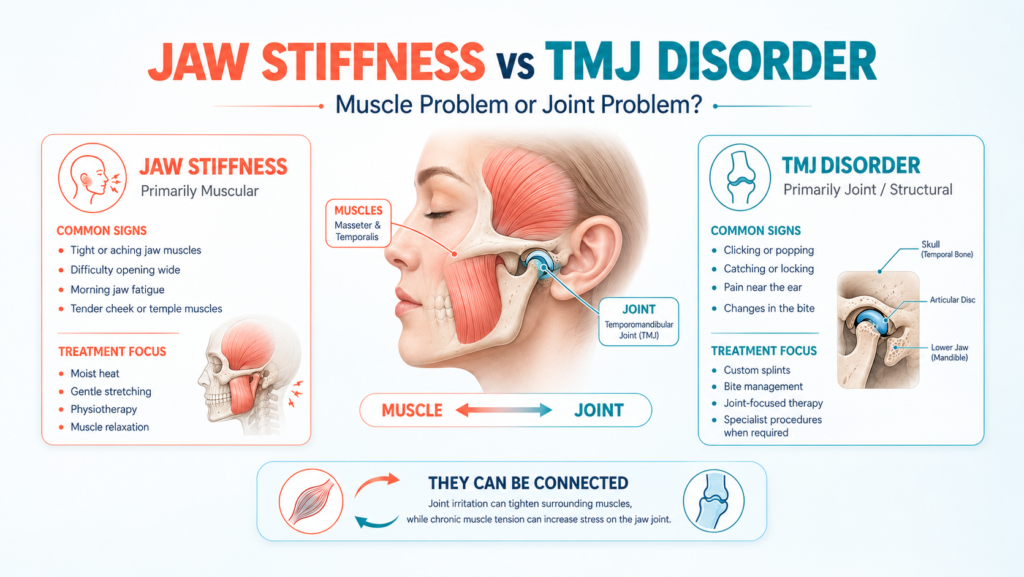
In clinical dentistry, jaw stiffness and temporomandibular joint (TMJ) disorders represent two related yet distinct entities. While patients might experience both simultaneously, their diagnostic protocols and treatment strategies differ significantly. This week, Your Healthy Smile Dentists discuss everything you need to know about jaw stiffness treatment vs TMJ treatment.
Key Points to Remember
- Jaw Stiffness is predominantly a muscular condition characterised by limited mouth opening (trismus). Treatment centers on stretching, moist heat, physiotherapy, and muscle relaxation.
- TMJ Disorders are predominantly articular structural conditions involving the joint, disc, and bone. Treatment centers on custom splints, bite management, joint lavage, intra-articular therapy, or surgery. Treating one condition often helps the other, as muscle spasm and joint breakdown reinforce each other in a continuous cycle.
Jaw Stiffness Treatment vs TMJ Treatment: What Is the Difference?
To understand it better, it helps to divide the lower face into two distinct anatomical components. This includes the muscles that move the jaw and the delicate hinges that connect the jawbone to the skull.
Jaw Stiffness Treatment focuses primarily on the muscular and soft tissue components of the masticatory system. The goal here is to relieve muscle spasm, break soft tissue contracture, reduce inflammation, and restore vertical range of motion.
TMJ Treatment focuses primarily on the intra-articular and structural components of the temporomandibular joint complex. This is where managing joint alignment, controlling inflammation, and preventing bone degeneration can become the prime area of focus for Your Healthy Smile Dentists.
Recognising the Signs: Muscles or Joints?
Because the muscles and joint structures work together continuously during chewing and speaking, symptoms can easily overlap. However, paying attention to specific signs can help clarify the source of discomfort.
Muscular stiffness typically presents as:
- A dull, aching sensation spread across the cheek area or temples.
- A feeling of tightness or fatigue upon waking in the morning.
- Noticeable difficulty opening the mouth wide to eat, yawn, or speak.
- Tenderness when applying light pressure directly to the cheek muscles.
Joint involvement typically presents as:
- Distinct popping, clicking, or grating noises when opening or closing the mouth.
- A mechanical sensation that the jaw is catching, sticking, or locking.
- Sharp discomfort located directly in front of the ear canal.
- Subtle changes in how the upper and lower teeth meet together when biting.
In many instances, joint irritation causes surrounding muscles to contract as a protective reflex. Conversely, chronically tight muscles can pull the joint out of balance. This interconnected relationship is why a detailed evaluation by searching for a dental clinic near me is important. If you are located in Australia, searching for TMJ treatment Sydney can help you find the right answers after a thorough diagnosis.
Targeting the Muscles: What Jaw Stiffness Care Involves
When muscle tension is identified as the primary source of trouble, the goal of care is to interrupt the muscle spasm cycle and promote tissue recovery.
Initial management strategies may include:
- Applying moist heat to the side of the face to encourage circulation and relax muscle fibres.
- Guided physical therapy and gentle stretching exercises to restore vertical movement gradually.
- Short term use of anti-inflammatory medication as advised by a health professional.
- Identifying daily habits such as daytime clenching, posture stress, or chewing on pens.
For persistent muscle knots, physical therapy collaboration or targeted clinical therapies may be discussed as part of a comprehensive management plan. During these, Your Healthy Smile Dentists emphasise gentle, careful methods to help the overworked tissues relax.
Targeting the Joint: Options for TMJ Treatment
When the hinge structure itself requires support, a focused treatment approach becomes necessary. Comprehensive TMJ treatment aims to reduce pressure inside the joint space, protect joint surfaces from excessive friction, and maintain balanced alignment.
Depending on your needs, options may include:
- Customised occlusal splints or nightguards worn over the teeth to absorb heavy bite forces and relieve joint pressure during sleep.
- Detailed occlusal evaluation to ensure chewing forces are distributed evenly.
- Collaborative care with allied health professionals, including specialised physiotherapists.
- Minor clinical procedures, such as joint flushing or intra-articular therapies, when conservative options require additional support.
When exploring TMJ treatment Sydney, it is important that every care plan is personalised specifically to your unique conditions for quicker relief.
Finding a Dental Clinic Near Me for TMJ Treatment Sydney
If you are currently searching for a trusted dental clinic near me to assess ongoing jaw tightness or joint noises, Your Healthy Smile Dentists can help.
Your Healthy Smile Dentists can help you to identify the underlying causes of your discomfort and design a path toward lasting comfort. A quick consultation with us can help you avoid a minor muscle strain or joint irritation from developing into a long term issue.
Disclaimer: Any surgical or invasive procedure carries risks. Before proceeding with treatment, you should seek an opinion from a qualified health practitioner or discuss it directly by reaching out at (02) 9670 6991.
FAQs
1. What is the main difference between jaw stiffness and a TMJ disorder?
Jaw stiffness involves overworked, tight chewing muscles restricting opening. A TMJ disorder involves structural dysfunction of the joint, cartilage disc, or bones, causing clicking, pain, or locking.
2. What causes sudden jaw stiffness on one side of the face?
It stems from muscle spasms, clenching, wisdom tooth inflammation, prolonged mouth opening during dental work, acute facial trauma, or sudden cartilage disc displacement within the joint.
3. Can stress or anxiety cause both jaw tightness and TMJ pain?
Yes. Stress triggers involuntary clenching and grinding. This overworks facial muscles to cause stiffness and increases mechanical pressure on the joint, leading to structural inflammation.
4. What is the three finger test for testing jaw mobility?
This self test checks vertical opening by fitting three stacked fingers vertically between the front teeth. Inability to do so suggests restricted mobility, trismus, or joint derangement.
5. Is jaw clicking always a sign of a severe TMJ disorder?
No. Painless clicking is common and often benign, indicating slight disc movement. Treatment is only required if clicking accompanies pain, locking, swelling, or limited movement.
6. Does wearing a night guard help with jaw stiffness or TMJ problems?
Yes. A custom night guard cushions bite forces, reducing muscle strain to ease morning stiffness. It also stabilises the joint position to relieve pressure on internal structures. Read more about it here.
7. Can wisdom teeth extraction cause temporary or permanent jaw stiffness?
Yes. Post operative trismus is common due to temporary tissue inflammation, extended mouth opening, or muscular strain. It usually resolves within two weeks using gentle heat and stretching.
8. Can poor body posture lead to chronic jaw tightness and TMJ dysfunction?
Yes. Forward head posture strains neck and hyoid muscles, pulling the mandible backward. This causes chronic muscle fatigue and compresses the temporomandibular joint space.
9. What steps should be taken if the jaw suddenly locks open or closed?
Remain calm and avoid forcing the jaw. Apply a warm compress, eat soft foods, and seek immediate professional dental care for gentle joint reduction.
10. When is surgery considered necessary for a TMJ condition?
Surgery is a last resort for severe cases that fail conservative care. It addresses structural joint damage, advanced osteoarthritis, internal derangement, or joint ankylosis.

Dr Lekha Menon
Dr. Lekha Menon is the Principal Dentist at Your Healthy Smile. She graduated from dental school in 1998 and has over 25 years of experience, serving the St Clair community since 2007. She provides personalised dental care with expertise in general and cosmetic dentistry, Invisalign®, orthodontics, dental implants, crowns, veneers, dentures, and root canal therapy.