
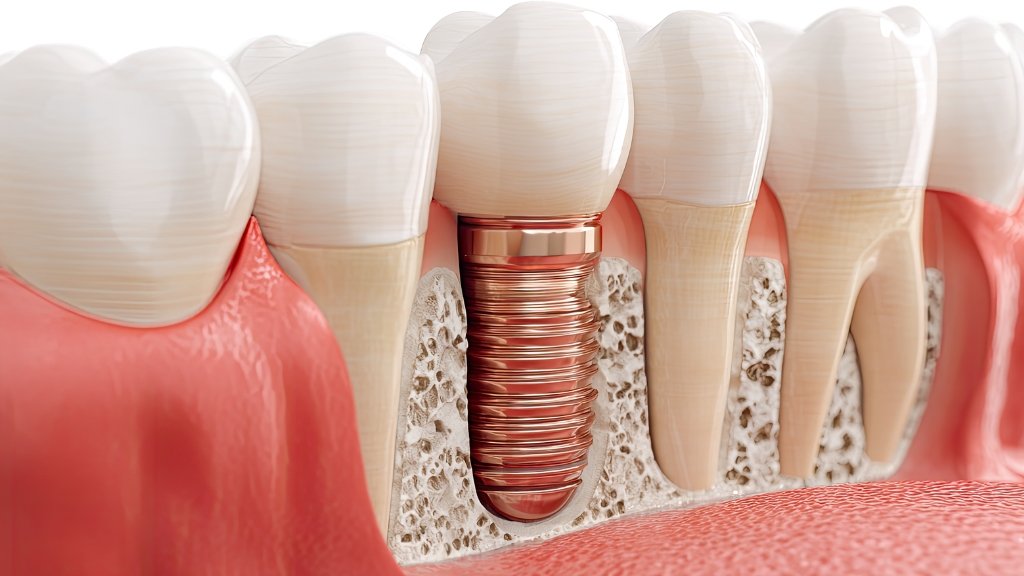
Today, a tooth implant is primarily crafted from medical-grade titanium alloys or high-strength zirconia ceramics. These specific materials are chosen for their exceptional biocompatibility, i.e., they can fuse directly with the human jawbone, through a biological process called osseointegration, without being rejected by our immune system.
What is a Tooth Implant?
A dental or a tooth implant is a biocompatible component that interfaces with your jawbone to support a crown, bridge or denture.
Unlike traditional dentures, which can slip, a dental implant acts as a synthetic root and provides better stability.
We can categorise a tooth implant by the placement method, i.e., Endosteal or Subperiosteal (in/on the bone), the number of teeth replaced (single, multiple, full arch), and the tooth implant material itself.
Components of a Tooth Implant
- The Fixture (The Implant): The screw-like post made of titanium or zirconia that acts as the root.
- The Abutment: A connector piece that sits at the gum line. This is often made from a similar tooth implant material to the fixture, though gold or surgical-grade stainless steel is occasionally used.
- The Crown: The visible part of the tooth, usually crafted from porcelain or high-strength ceramic to match the natural colour of your surrounding teeth.
What is Your Tooth Implant Made From
-
Titanium and Titanium Alloys
Titanium’s significant advantage is osseointegration, a process where the jawbone grows directly onto the metal surface.
Most implants use Grade 4 titanium, which offers an ideal balance of strength and corrosion resistance.
This higher grade titanium offers an increased tensile strength to withstand the strong biting forces.
-
Zirconia (Ceramic)
Zirconia is a newer alternative to titanium. It is a non-metal, ceramic material (Zirconium Dioxide) that appeals to patients who prefer a metal-free restoration or have a thin gum.
Because zirconia is white, it avoids the slight greyish shadow that titanium can sometimes cast through the gums.
Furthermore, it is highly resistant to chemical corrosion and bacterial adhesion, which is beneficial for long-term gum health.
Comparing the Two Tooth Implant Materials
It is important to know what the two materials offer to help you understand the tooth implant cost.
| Aspect | Titanium | Zirconia |
| Material Type | Metal Alloy | Ceramic |
| Success Rate | Long-term proven track record | High, but shorter clinical history |
| Allergy Risk | Extremely low (rare) | Virtually zero |
| Flexibility | Higher (two-piece systems common) | Lower (often single-piece) |
What To Know When Considering a Tooth Implant
Choosing an experienced dentist helps because long-term success of an implant is deeply rooted in expertise over preventive dentistry.
- Your lifestyle factors play a significant role, where smoking and uncontrolled diabetes can increase the risk of implant failure.
- Post-operative care must primarily constitute a soft-food diet for the first few weeks.
- While the implant itself cannot decay, the surrounding gum tissue and bone are susceptible to infection (peri-implantitis) if oral hygiene is neglected.
In Australia, when you’re searching for the best dentist near me, ask if they are registered with the Dental Board of Australia and uphold rigorous clinical standards set by Australian Dental Association (ADA).
What Affects the Tooth Implant Cost
When considering this procedure, patients often find that the tooth implant cost varies. Your Healthy Smile Dentists would like you to know that the total price is influenced by various factors such as:
- The type of material used (Zirconia is often more expensive than Titanium).
- The need for preparatory procedures, such as bone grafting or sinus lifts.
- The level of expertise of the dentist and the location of the clinic.
And while the initial cost might seem higher than alternatives like dental bridges, an implant lasts for decades to lifetime, making it a more cost-effective solution.
Get The Right Dental Care at Your Healthy Smile in St Clair
While tooth implant cost can vary depending on the complexity of your case, Your Healthy Smile Dentists can help in managing the expenditure.
- Platforms like Afterpay can be utilised to receive the care and pay later in installments.
- Health funds and HICAPS can be considered for easy claims.
- Major credit cards can be utilised to avail a dental implant.
If you still have questions, you can schedule a dedicated guidance session to discuss more on its suitability for you.
FAQs
Q1. Can I get an implant if I have significant bone loss?
Yes. In cases where the jawbone is too thin or soft, a bone graft or sinus lift can be performed to create a solid foundation for the implant.
Q2. Is there an age limit for dental implants?
There is no upper age limit as long as the patient is in good health. However, implants are generally not recommended for children or teenagers whose jawbones are still growing.
Q3. Can smokers get dental implants?
Yes, but the risk of failure is significantly higher. Smoking restricts blood flow to the gums and can interfere with the healing process. We strongly recommend quitting or reducing intake during the treatment period.
Q4. What is ‘All-on-4’ in the dental implant process?
This is a technique where an entire arch of prosthetic teeth is supported by just four strategically placed implants. It is one of the suggested solutions for patients who have lost all their natural teeth.
Q5. Can I be allergic to a tooth implant?
Titanium allergies are extremely rare. If you have a known metal sensitivity, zirconia is an excellent, 100% metal-free alternative.
Q6. Will a tooth implant set off airport metal detectors?
No. Titanium and zirconia are non-magnetic and will not trigger standard security scanners.
Q7. Can I get an implant immediately after an extraction?
In many cases, an implant can be placed on the same day as the extraction, provided there is no active infection and enough bone support is present. You can call (02) 9670 6991 to discuss more.
Q8. Will my new tooth implant look natural?
Yes. Modern porcelain crowns are custom-shaded to match the translucency and colour of your existing teeth perfectly.