
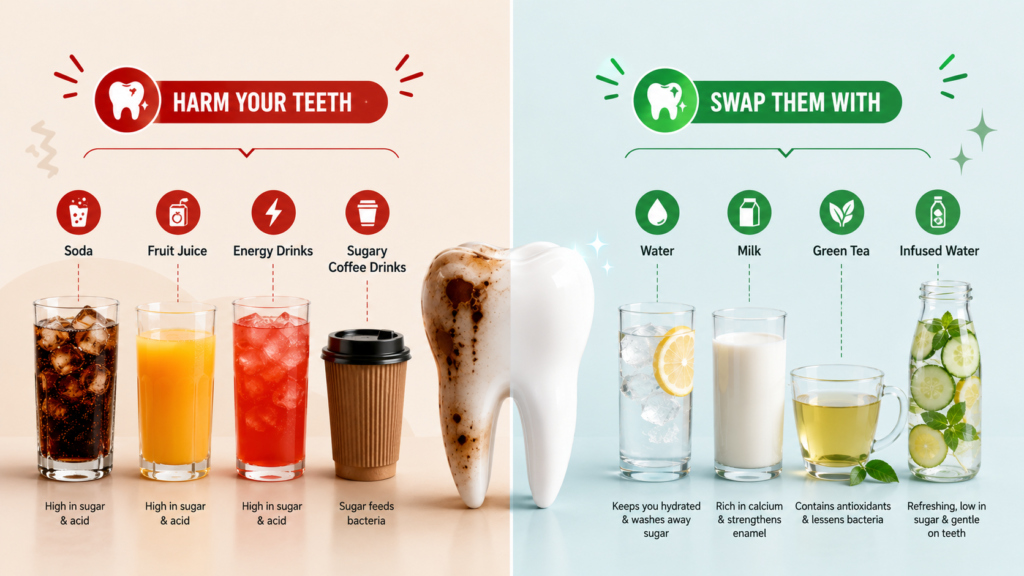
Our beverages help us wake up, hydrate, and even feel energised throughout the day. But are they completely harmless? Preventive dentistry offers a list of drinks that harm your teeth with ones that can be replaced with safer choices. This includes green tea instead of coffee, soy milk over oat milk, and the good ol’ water over a fizzy drink.
Why is Acidity a Critical Factor in Oral Health and Beverages?
The mouth operates within a specific pH range to maintain the mineral balance of the teeth. When the environment becomes too acidic, demineralisation begins, stripping the tooth’s hard protective layer.
- Enamel, the hardest substance in the human body, begins to demineralise when our mouth’s pH drops below 5.5.
- Bacteria in this film ferment sugars to produce acid, but many modern beverages are inherently acidic even before they come into contact with bacteria!
This leads to direct chemical erosion that thins our enamel. It can cause an array of sensitivity issues and even structural failure if not acted upon.
Which Beverages Pose the Greatest Risk?
Identifying drinks that harm your teeth involves looking beyond just sugar content. We see how several beverages that, while marketed as healthy, pose significant risks to dental health.
Beyond sodas, Your Healthy Smile Dentists find that many such choices include:
- Commercial Fruit Juices: These often have a pH level comparable to vinegar. The high concentration of citric acid softens the enamel immediately upon contact.
- Energy and Sports Drinks: These are formulated for performance but often contain high levels of phosphoric or citric acid to balance their sweetness. This combination creates an aggressive environment for dental tissues.
- Dry Wines: Both red and white varieties are highly acidic. White wine, in particular, can be more erosive, making the tooth surface more porous and susceptible to staining from other foods.
Did you know? Stephan Curve illustrates that every time you consume an acidic beverage, your teeth remain in a state of acid attack for approximately twenty to thirty minutes.
Which are the Better Effective Substitutions?
To maintain the standards of preventive dentistry, swaps must be based on the biochemical properties of the replacement material’s ability to protect or restore the tooth surface.
1. Swap Coffee for High-Quality Green Tea
Why? Green tea contains specific polyphenols, particularly epigallocatechin gallate, which actively inhibits the growth of Streptococcus mutans. This prevents the bacteria from adhering to the tooth surface and reduces the overall acid production in the biofilm.
2. Swap Oat Milk for Calcium-Fortified Soy or Dairy Milk
Why? Oat milk is naturally high in maltose, a sugar that is easily fermented by oral bacteria. In contrast, dairy and fortified soy milks contain casein and phosphates that form a protective film over the enamel, directly aiding the remineralisation process.
3. Swap Fizzy Drinks for Mineral Water
Why? Mineral water often contains natural bicarbonates. These act as an alkalising agent, helping to buffer the mouth against acidity and supporting the natural saliva flow, which is essential for washing away food debris and neutralising acids.
The Effects of Sipping on Drinks That Harm Your Teeth
A hole in gum.
This common observation is a localised recession or a visible hole in gum tissue near the base of a tooth. It often indicates that enamel erosion has progressed to the point where the underlying dentine or root surface is exposed.
What we observe is that if a hole in gum appears alongside persistent sensitivity or swelling, it may signify a deeper issue that cannot be managed with dietary changes alone.
Ignoring it can lead to the progression of an abscess, which necessitates emergency dental care to save the tooth and prevent the spread of infection.
How Dental Check up and Clean Helps?
While informed dietary swaps reduce the daily chemical burden on your teeth, they cannot remove the calcified deposits. In such cases, a professional dental check up and clean can eliminate these bacterial reservoirs.
- Modern preventive dentistry focuses on early detection.
- By identifying areas of thinning enamel or the early stages of a hole in gum tissue, minimally invasive treatments are possible.
- Neglecting it can contribute to gum disease and hidden cavities.
It is evident that a proactive approach can reduce the likelihood of a complex emergency dental care in future.
Shift To Better Choices, One Sip At a Time
By helping you make informed choices about daily hydration and prioritising routine clinical visits, it is possible to maintain a functional and aesthetic smile for life.
However, if you have concerns about existing damage or wish to establish a more robust oral hygiene routine, Your Healthy Smile Dentists are here to guide you with gentle expertise. But before you do that, don’t forget to have a glass of water!
FAQs
Q1. Does adding lemon to water make it one of the drinks that harm your teeth?
While lemon water is popular for hydration, the citric acid it contains significantly lowers its pH. Frequent exposure can dissolve the enamel minerals. To minimise damage, we suggest drinking it in one sitting rather than sipping over hours and rinsing with plain water afterwards.
Q2. Can using a straw prevent enamel erosion?
A straw can help by directing the liquid towards the back of the mouth, bypassing the teeth. However, it is not a complete solution, as the liquid still circulates in the oral cavity. It is most effective when used with cold, acidic beverages.
Q3. Is sparkling water as damaging as sugary fizzy drinks?
Plain sparkling water is less damaging than sugared versions because it lacks fermentable sugars. However, it still contains carbonic acid. While it is a better choice, it should not entirely replace still water, which is neutral and often contains protective minerals.
Q4. Can red wine stains be reversed at home?
While whitening toothpastes can remove some extrinsic surface stains, they cannot change the internal colour of the tooth. Professional whitening is more effective and safer for the enamel, as many home kits are overly abrasive or acidic.
Q5. How often is a dental check up and clean necessary for heavy tea drinkers?
For those who consume several cups of tea daily, a dental check up and clean every six months is vital. This frequency ensures that tannin stains are managed and that any early signs of acid erosion are addressed through preventive dentistry protocols.
Reviewed By Dr. Lekha Menon