
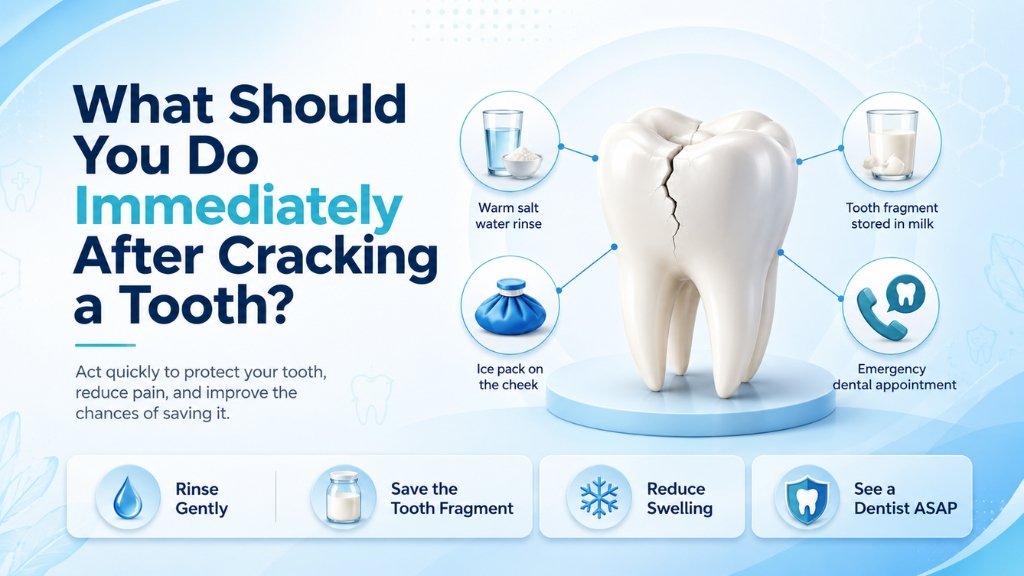
Having a cracked tooth can be a painful and distressing experience. But knowing exactly what to do after cracking a tooth makes the difference between needing a total extraction and a reassuring answer for can a cracked tooth be fixed.
The Immediate Steps
1. Clear the Area
Rinse your mouth gently with warm salt water. This cleans out debris, calms the surrounding soft tissues and minimises the initial risk of bacterial infection.
2. Shield the Peripheral Region
If the remaining tooth structure has a sharp or jagged edge, it can slice your cheek. We suggest covering the sharp edge with a small piece of chewing gum or to create a smooth cushion.
3. Preserve the Fragment
If a piece of the tooth broke off completely, attempt to retrieve it. Rinse it very gently under water without scrubbing the surface. Store the fragment in a small container filled with whole milk or your own saliva to keep the living cells hydrated.
4. Manage Inflammation Safely
Apply a cold pack or a bag of ice wrapped in a cloth to the outside of your cheek to reduce swelling. While paracetamol or ibuprofen are effective, we warn you not to press a painkiller directly against the gum tissue to avoid severe chemical burns.
Did you know? A cracked tooth differs from a chipped tooth in many ways, and their remedies differ too.
When Can a Cracked Pose a Concern?
While a visible chip is easy to spot, many fractures extend deep into the tooth and can cause serious, invisible damage.
1. Sharp Pain on Bite Release (Cracked Tooth Syndrome)
Have you noticed that your tooth feels fine when you bite down on food, but then gives a sharp, stabbing flash of pain the exact moment you release the pressure?
This is a condition called cracked tooth syndrome.
Virtually hidden to the naked eye, it indicates that the tooth structure is moving and requires immediate professional stabilisation to prevent further splitting.
2. Pain That Travels (Referred Pain)
A deep, non-specific ache that feels like it’s in your jawbone, ear, or even down your neck could be ‘referred pain’ from the injured tooth.
The extensive nerve damage caused by a deep crack can confuse your nerve pathways, making you feel the pain somewhere other than the original source.
3. The Problem with No Pain (Pulp Necrosis)
A common mistake is assuming that if the severe pain suddenly stops after a few days, you’re fine. This phantom recovery is a serious warning sign.
It often means the internal bacterial invasion has successfully killed the inner tooth nerve (called the pulp).
This is where the infection continues to advance downwards into your jawbone, forming a painful abscess.
If you experience this, it is advisable you seek immediate care through emergency consultation at our St Clair dental clinic.
4. A Small Bump on Your Gums (Fistula)
The appearance of a tiny, pimple-like bump on the gums indicates a localised infection is actively draining. This is called a fistula.
This too requires rapid intervention to prevent irreversible bone loss around the root.
Additionally, we also suggest monitoring the gum area around the injured tooth and letting our dentists in St Clair know if you notice any discomfort.
Can Your Cracked Tooth Be Saved?
After knowing what to do after cracking a tooth, the next important question is can a cracked tooth be saved?
Your Healthy Smile Dentists find that the answer depends entirely on the direction, depth, and specific location of the fracture line.
In the table below, we classify the damage to determine the possible treatment pathway.
| Signs | Description | Action Plan |
| Craze Lines | Tiny, superficial cracks confined to the outer enamel surface. These do not weaken the tooth structure. | Primarily a cosmetic concern and usually do not require intensive treatment. |
| Fractured Cusp | A portion of the chewing surface breaks away, commonly around an existing filling, while the tooth remains largely intact. | Typically restored with a dental crown or onlay/overlay. The dental pulp is rarely affected in this case. |
| Split Tooth | A deep vertical crack that extends through the tooth, separating it into distinct, movable segments. | The tooth generally cannot be preserved as a single unit. Extraction of the affected segment or the entire tooth is often required. |
| Vertical Root Fracture | It is where a crack that begins in the root and extends toward the chewing surface, usually beneath the gumline and out of sight. | Often difficult to diagnose on conventional X-rays. Treatment may involve root canal therapy, surgical management, or extraction depending on the extent of the fracture. |
Book Your Consultation
Time is the most critical factor when you have a cracked tooth. In most cases, waiting alone does not guarantee restorative healing.
It simply gives the bacteria a window to colonise and might turn a simple remedy into a root canal procedure.
If you are searching for an emergency dentist near me, Your Healthy Smile Dentists at 154 Bennett Rd, St. Clair, can offer comfort and priority dental care.
Call us at (02) 9670 6991 to secure an urgent assessment.
FAQs
1. Can a cracked tooth heal itself over time?
Unlike a broken bone, a fractured tooth cannot heal itself. Tooth enamel does not contain living cells capable of regenerating or repairing a physical split. Once a crack develops, it remains permanent and will gradually expand under the constant pressure of everyday chewing.
2. What can happen if a fractured tooth is left untreated?
Leaving a crack alone allows bacteria from your saliva to enter the inner pulp chamber. This neglect can lead to a severe bacterial infection, a painful abscess, permanent nerve death, or progressive bone loss around the root structure. Eventually, a complete tooth extraction becomes the only viable option.
3. Can you eat with a cracked tooth?
It is critical to avoid chewing on the side of your mouth where the fracture is located. Stick to soft, lukewarm foods such as smoothies, mashed vegetables, or plain soup. Avoid hard, crunchy, sticky, or extremely hot and cold substances that could trigger severe pain or widen the physical split.
4. Why does a cracked tooth hurt when drinking cold water?
When a tooth structure is fractured, the outer protective layers of enamel and dentine are compromised. This structural breach allows temperature extremes to reach the inner soft pulp, which contains highly sensitive nerve endings, causing a sharp thermal shock.
5. Will a cracked tooth always require a root canal treatment?
A root canal treatment is only necessary if the fracture line extends deep enough to breach, expose, or permanently irritate the inner nerve chamber. If the crack is superficial or limited strictly to the chewing surface cusp, a standard composite filling or a protective dental crown will usually suffice.
6. Can a cracked wisdom tooth be fixed, or must it be extracted?
Repairing a cracked wisdom tooth is highly uncommon because these teeth are located far back in the oral cavity, making them exceptionally difficult to clean and restore effectively. If a wisdom tooth suffers a significant fracture, we recommend extraction to prevent recurrent infections. Read more about it in our blog.
Reviewed By Dr. Lekha Menon