
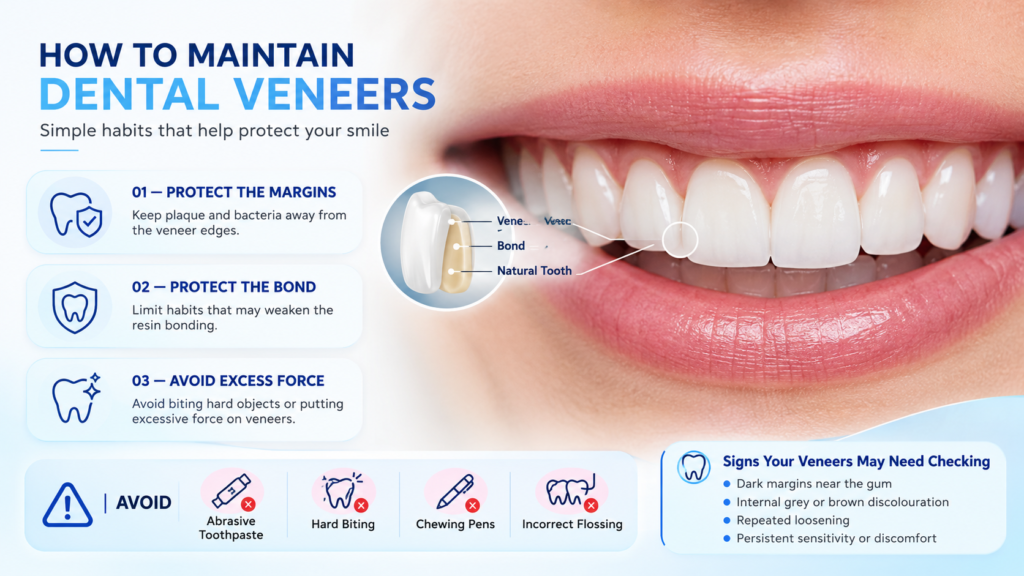
To maintain dental veneers, you need to prevent marginal decay and microleakage, protect their resin bonding, and be careful about what and how you chew.
So, what are the common mistakes when one wants to maintain dental veneers? When is it time to replace them? And how to maintain dental veneers correctly?
For Your Healthy Smile Dentists, it begins with these strategies.
Prevent Marginal Decay and Micro-leakage of Dental Veneers
The weakest point of your veneer is its margin, the microscopic junction where the restoration meets your natural tooth structure.
If bacteria infiltrate this seam, it causes micro-leakage, leading to internal staining and decay beneath the veneer.
To maintain dental veneers in this case, consider:
- Prescription high-fluoride therapy: Using a high-fluoride paste for nighttime strengthens the exposed margins.
- Xylitol integration: Having xylitol mints or gum stimulates saliva flow and stabilises the oral microbiome.
🦷 A GAP-free dental checkup and clean session is where we can comfortably discuss the suitable products and plan for you.
Protect the Resin Bonding Around Your Dental Veneers
Veneers are secured using a light-cured resin cement. This bonding matrix is susceptible to chemical degradation from specific lifestyle habits.
Let’s understand what weakens the bond:
- Restrict alcohol-based products: Check the ingredients of oral rinses and cosmetic lip products. Ethanol is known to break down the polymer chains within resin cements over time.
- Acidic/sour foods: Frequent consumption of beverages like lemon water, kombucha, or apple cider vinegar can etch the glaze layer of porcelain or accelerate the erosion of composite resin interfaces.
🦷 Difference in dental veneers vs. bonding? Veneers are shells covering the entire front tooth surface, whereas dental bonding, or resin bonding, uses a tooth-coloured composite resin sculpted directly onto teeth.
Avoid Functional Stresses and Trauma
Functional forces put immense stress on the shear bond strength of the veneer.
- Bite force redirection: We advise training yourself to use your premolars and molars. Biting with your front teeth can shear the veneer away from the enamel.
- Awareness: Be mindful chewing on pen caps or holding items between your teeth. These cause microfractures in the structure.
Sometimes, uneven pressure can transfer impact directly onto veneers. To avoid more damage, get your occlusal splint or nightguard evaluated at every dental visit.
🦷 Want us to inspect your dental splints? Read our tips on cleaning your splints and call (02) 9670 6991.
Common Mistakes That Harm Your Dental Veneers
Perhaps the most important question after how to maintain dental veneers is how not to do it.
1. Using Whitening Toothpastes and Abrasive Cleaners
The Mistake: Many try to brighten their smile with highly abrasive whitening toothpastes, charcoal powders, or baking soda formulas.
What Happens: Abrasive particles strip away the glaze of the porcelain. This creates a rough finish that traps food stains and plaque.
2. Vertical Floss Extraction
The Mistake: Pulling dental floss straight back up through the gap between teeth after clearing plaque.
What Happens: Snapping the floss vertically can weaken the bond or chip the margin due to prying. You can learn the safe ways to floss your teeth.
3. Assuming Unrealistic Immunity
The Mistake: Because porcelain cannot decay, oral hygiene or professional monitoring can be neglected.
What Happens: The rear surface and the root is where plaque accumulation leads to decay. Clarifying expectations and knowing how long does a smile makeover lasts can help.
When to Replace Your Dental Veneers
When maintenance efforts don’t work, it is important to know when it is smarter to replace your dental veneers.
| Visible Sign | Possible Cause | Why Replacement is Required |
| Dark lines at the gum line | Gum recession exposing the veneer margins | Replacing the veneer restores a seamless appearance while protecting the newly exposed tooth surface. |
| A dark grey or brown tint from within | Internal staining of the veneer or underlying tooth | Internal discolouration cannot be removed with polishing or whitening, making replacement the most effective solution. |
| Continuous loosening | Bond failure or gradual enamel breakdown | A new veneer is needed to establish a secure bond and restore long-term stability. |
| Intermittent tooth sensitivity or pain | Hidden decay beneath the veneer | The veneer must be removed so the decay can be treated before a new restoration is placed. |
Need Help With Your Dental Veneers?
When your dental veneers show signs of decay or bond failure, delaying its replacement can lead to dental issues.
This is where a professional inspection by our St Clair orthodontic practice proves helpful when searching for an orthodontic near me.
Your Healthy Smile Dentists can help know the right time for replacement, the right answers for how to maintain dental veneers, and the difference between dental veneers vs. bonding.
If you need further help to maintain dental veneers, Your Healthy Smile Dentists are available at 154 Bennett Rd, St. Clair.
FAQs
1. Can veneers stain from foods like turmeric or coffee?
High-quality porcelain is completely non-porous and highly resistant to surface stains. However, composite resin restorations and the thin lines of bonding cement used around porcelain panels can absorb pigments over time. Regular consumption of berries, red wine, turmeric or black coffee can discolour these.
2. Why do my veneers smell bad or cause chronic bad breath?
An unpleasant odour usually indicates that plaque, food debris, or bacteria are trapped along the microscopic margins. This occurs if the restoration was poorly fitted, creating a ledge, or if your daily flossing technique is inadequate. It is a sign that requires a professional assessment to check for underlying decay. Contact (02) 9670 6991 for more information.
3. Is it safe to use an electric toothbrush on porcelain veneers?
Yes, electric toothbrushes are safe and highly effective at removing plaque from restorations and the gum line. Ensure you use a soft brush head and avoid applying heavy physical pressure against the margins while cleaning.
4. Can I use a water flosser on my dental restorations?
A water flosser is an excellent supplemental tool for flushing out loose debris from tight spaces. However, it cannot completely replace traditional dental floss, which is necessary to physically scrape away the sticky biofilm from the sides of the teeth.
5. Can you switch from composite veneers to porcelain veneers later?
Yes, upgrading from composite to porcelain is a very common procedure. When older composite restorations begin to stain or wear down, a clinician can gently remove the resin layer and replace them with more durable, stain-resistant porcelain panels. Know more about both at reception@yourhealthysmile.com.au.
Reviewed By Dr. Lekha Menon