
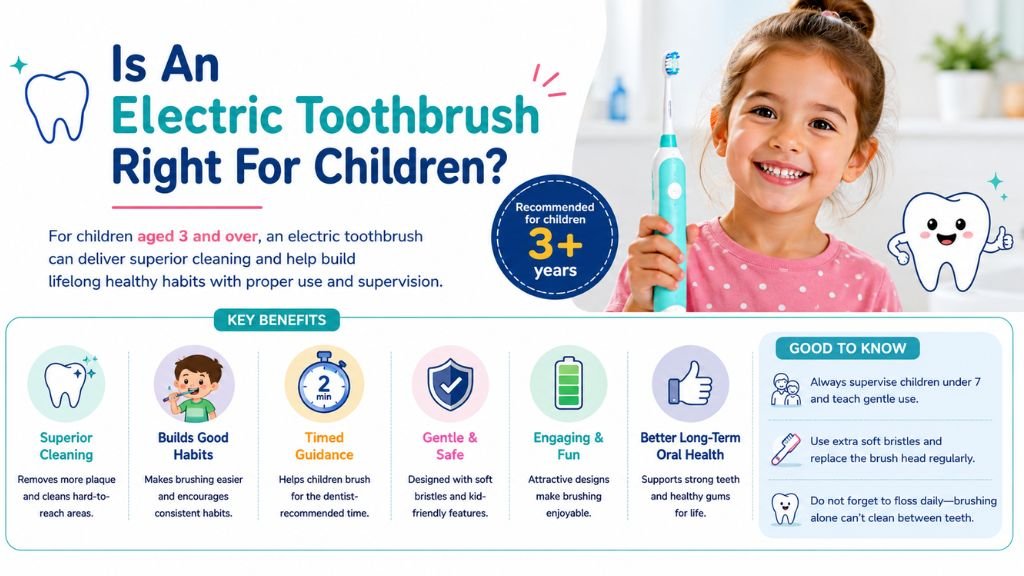
Yes, an electric brush for children aged 3 and over is ideal and safe. It can deliver superior cleaning and oral hygiene control, provided there are no severe sensory issues or active mouth injuries. Let’s understand the benefits of an electric toothbrush, who should avoid it, and what you must look for when buying one.
When To Introduce Electric Brush For Children
We recommend waiting until a child reaches three years of age before introducing any powered oral care device. Before this milestone, the tissues of the gums and the developing enamel are highly sensitive to rapid mechanical vibrations.
Once your child turns three, moving to a specialised electric brush for children can significantly enhance plaque removal and build lifelong hygiene habits. But before that, manual brushing remains the safest and most controllable option for infants and toddlers.
How Effective Are Electric Brush For Children
The primary benefit of this transition lies in mechanical efficiency and ease of use.
- Developing Motor Skills: Young children are still developing their manual dexterity, coordination, and grip strength, which can make manual brushing inconsistent.
- Complex Motion Replacement: A standard manual brush requires a precise circular sweeping motion that many children under seven cannot execute correctly.
- Automated Stroke Delivery: A premium electric brush for children solves this problem by delivering thousands of gentle micro-movements per minute automatically.
- Superior Plaque Removal: This automated action removes far more plaque than manual effort alone, effectively cleaning hard-to-reach areas and navigating tricky gaps in the mouth.
When You Shouldn’t Consider Electric Brush For Children?
While these devices offer remarkable benefits, they are not universally suitable for every child or every situation. Parents must exercise caution or temporarily revert to manual alternatives under specific clinical circumstances:
- Children Under Three Years Old: The delicate oral structures, thin enamel, and developing jawbones are ill-suited to intense mechanical vibrations.
- Children with Severe Sensory Sensitivities: Buzzing sounds and high-frequency tactile sensations can cause sensory overload, leading to long-term negative associations with oral hygiene.
- During Recovery from Oral Trauma: If a child has recently undergone a tooth extraction, sustained a mouth injury, or developed painful oral ulcers, rapid movements can disrupt healing tissues.
- Habitual Toothbrush Chewers: Children who bite down hard on objects can break plastic components or cause nylon filaments to fall out rapidly, risking gum bruising.
- Unsupervised Children Under Seven: Young children often apply excessive pressure or hold the vibrating head stationary at a single spot, which can accelerate enamel wear or gum recession over time.
Fine Details to Prioritise When Selecting an Electric Brush For Children
As a parent, you must know that not all electric toothbrushes are the same. When browsing options for a kids electric toothbrush, look closely at these specific technical and structural features:
- Extra Soft Filaments: Children possess much thinner enamel than adults, meaning standard adult filaments can cause microscopic damage to delicate oral tissues.
- Cushioned Outer Borders: Look for brush heads encased in a rubberised or soft moulded rim to damp accidental impacts against inner cheeks and gums.
- Variable Speed Settings: A gentle or sensitive mode allows your child to grow accustomed to the novel sensation gradually without fear.
- Integrated Pressure Sensors: Select a model that stops vibrating or flashes a warning light if the child presses too aggressively against the tooth surface.
- Rechargeable Power Cells: Charging bases maintain a steady motor speed and frequency, whereas battery-operated versions lose cleaning power as cells weaken.
- Four Quadrant Interval Pacing: A 30 second interval pacer alerts the child exactly when to move to the next mouth section, ensuring even coverage.
- Roll Resistant Stability: A flat ridge along the back of the handle keeps the device stable on bathroom counters for easy toothpaste application.
At our St Clair dental clinic, Your Healthy Smile Dentists often help with proper kids electric toothbrush usage.
What To Know When Using Electric Brush For Children
The most common mistake parents make is allowing children to scrub back and forth violently with a powered brush. This approach defeats the purpose of the motor and risks damaging the enamel. Teach your child to use the device systematically by following these steps:
- Place the head inside the mouth, against the teeth, at a 45-degree angle, before pressing the power button to avoid spraying toothpaste across the room.
- Navigate methodically through the four quadrants of the mouth, dedicating thirty seconds of focused attention to each distinct section.
- Have your child spit out the remaining foam, but do not rinse with water immediately, as leaving a trace of toothpaste helps protect the enamel.
- Always replace the brush head immediately after a child recovers from a viral or bacterial illness, such as strep throat, influenza, or a severe cold. Pathogens can survive within dense clusters of nylon filaments, potentially leading to reinfection.
- If a child resists the vibration of a powered brush, introduce the device in stages. Allow them to feel the vibration in their hand first, or let them brush the teeth of a favourite plastic toy to normalise the sound.
Crucially, remember that mechanical brushing does not replace flossing. Flossing must begin as soon as two teeth are adjacent to one another, typically around the ages of 2 or 3, to clean the tight gaps where teeth meet.
Need Help with Oral Hygiene of Your Little One?
In conclusion, electric toothbrushes are suitable for children once the right age, right technique, and right aftercare is considered by parents.
Every child presents a unique oral development pattern and jaw structure, meaning a one-size-fits-all approach to such dental products rarely yields perfect results. Selecting the right model requires assessing your child’s comfort level and suitability.
If you are searching for a dental clinic near you to ensure your child’s dental routine is on the right track, speak with Your Healthy Smile Dentists at (02) 9670 6991. Through consultation, we can guide with personalised measures for your little one.
FAQs
Q1. Is a sonic or an oscillating toothbrush better for children?
Sonic models use rapid side-to-side vibrations, which are gentler for sensitive mouths. Oscillating models spin back and forth, offering intense plaque removal. The choice depends on the child’s specific sensory tolerance.
Q2. Can children with autism or sensory processing disorders use electric toothbrushes?
It varies by individual. Some children enjoy the predictable rhythmic vibration, while others experience sensory overload from the motor noise. Your Healthy Smile Dentists suggest introducing the device turned off first, allowing the child to feel the vibration on their hand.
Q3. Why might a child complain of discomfort or tickling when using a powered brush?
The high frequency vibrations can stimulate nerve endings in the lips and gums, causing a tickling sensation. Most children adapt within two weeks. Using a sensitive or low speed setting helps during this adjustment phase.
Q4. How to clean and sanitise a powered toothbrush handle?
Remove the brush head after each use and rinse both components under warm running water. Wipe the handle with a clean damp cloth to prevent toothpaste residue from building up in the seals. Never submerge the entire unit in water.