
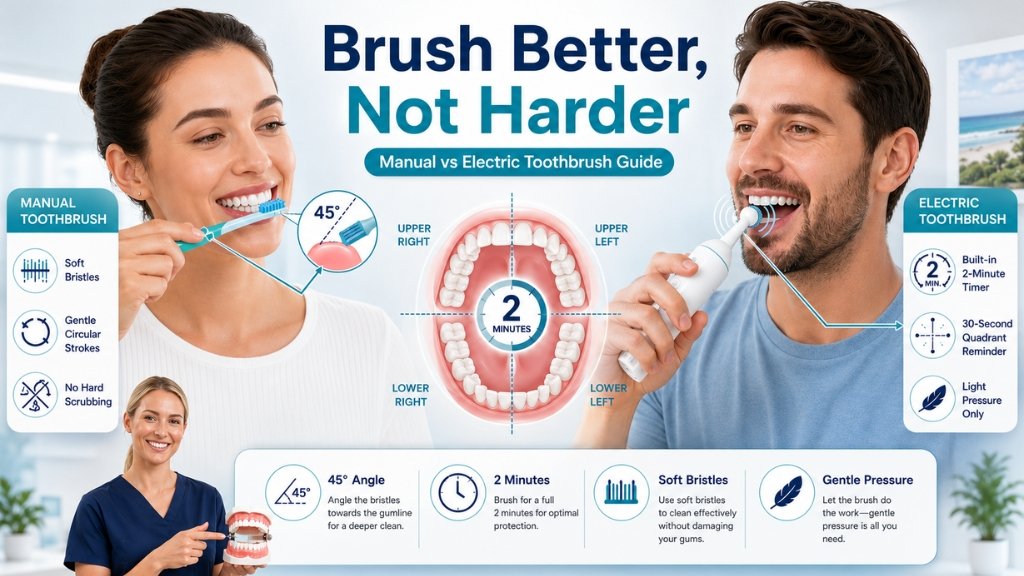
While both toothbrush types can support optimal oral health, they do so in different ways and fulfill different needs. This is where how you brush matters just as much as how often you brush and the type.
This week’s guide covers everything from the right toothbrush and bristle type to how to brush your teeth properly.
Understanding Toothbrush Types
Today, our choice lies between standard and electric toothbrushes. What defines it is our needs, age, and budget.
Manual Toothbrush
- Manual toothbrushes are highly affordable and widely available, making it simple for you to replace them every 8 to 12 weeks.
- However, since these brushes require manual effort, you might scrub too hard, which could wear down the protective enamel layer over time.
- Also, without a tracking mechanism, you will most likely stop the cleaning process before the required duration of about 2 minutes.
Electric Toothbrush
- Electric toothbrushes remove plaque more effectively when evaluated over longer periods.
- The integrated timers provide precise pacing to signal exactly when you should transition to a different section of the mouth.
- Unsurprisingly, the option does involve a relatively higher upfront cost and replacement of heads.
How Bristle Design and Softness Defines Your Oral Health
Selecting the correct bristle texture and pattern affects the outcome. Look out for these bristle features when the goal is knowing how to brush your teeth properly:
- Most popular ones are ultra soft or soft bristles because they easily flex beneath the gumline to lift debris without causing micro-trauma to tissues.
- Thin and tapered bristle designs help you reach deep into the narrow gaps between the teeth and below the delicate gum margins.
- Brushes that feature criss-cross or multi-level textures are engineered to tackle plaque from multiple angles simultaneously.
- Crucially, we observe that patients using medium or firm bristles often suffer from worn enamel and root exposure.
Apart from type, technique is equally important. To get the best results, let’s understand how to brush your teeth more effectively.
How To Brush Teeth Properly With a Manual Toothbrush
Did you know? It is observed that patients vigorously using firm bristles often suffer from worn enamel and root exposure. That is why technique is everything with a manual toothbrush:
- Hold the brush at 45-degree to your gum line.
- Use small, gentle circular or short back-and-forth strokes without scrubbing.
- Work through four quadrants: upper right, upper left, lower right, lower left, spending 30 seconds on each.
- Cover outer surfaces, inner surfaces, and biting surfaces of every tooth.
- Spit, do not rinse, so the fluoride stays active on your enamel.
Your Healthy Smile Dentists explain: Applying too much pressure is one of the most common missteps when learning how to brush your teeth properly. If the bristles are splaying outward within a few weeks of switching, you are pressing too hard.
How To Brush Teeth Properly With an Electric Toothbrush
Using an electric toothbrush calls for a different approach. The goal is to only guide the brush, not drive it.
- Angle the brush head at 45 degrees to the gum line, the same as a manual brush.
- Move slowly from tooth to tooth, pausing two to three seconds on each surface.
- Let the brush head do the oscillating or vibrating work (don’t scrub manually).
- Ease off the pressure.
- Follow the built-in timer and 30-second quadrant alerts to stay on track.
Your Healthy Smile Dentists explain: Adding extra force overrides the brush’s action, increasing the risk of gum irritation. This is where a light, controlled stroke with thorough coverage outperforms aggressive scrubbing.
Common Brushing Mistakes
At our St Clair dental clinic, we often attend perplexed visitors who brush twice a day to still find the results ineffective.
This happens because of:
- Too much pressure: Counterintuitively, this wears enamel and contributes to gum recession over time.
- Rushing: Under two minutes leaves plaque on overlooked surfaces.
- Skipping inner surfaces: The tongue-facing sides of teeth accumulate plaque just as readily as the outer surfaces.
Wondering how the choice of an electric toothbrush benefits children? Read our article that answers everything you must know.
Don’t Overlook the Professional Side
Brushing is the foundation of our oral health, but it has limits. For example, tartar that calcifies from uncleaned plaque can only be removed by a dental professional, not a toothbrush.
This is where Your Healthy Smile Dentists in St Clair address the early signs of decay, gum disease, and enamel erosion for you.
We offer holistic oral health care plans for all the members of your family and help you with the right choices. Plan yours by calling (02) 9670 6991 or searching for a dental clinic near me.
FAQs
Q1. Are electric toothbrushes safe for children?
The automated vibrations are entirely safe and can make daily cleaning routines more engaging for children. Also, the rapid bristle action helps to compensate for developing motor skills while they’re still establishing hand-to-eye coordination.
Q2. Are electric toothbrushes safe for seniors?
The elderly may find that the ergonomically thickened handles of electric options are much easier to grip securely. Additionally, they only need to guide the brush head slowly along the dental arch without straining the wrist.
Q3. Which toothbrush works best for orthodontic patients?
For individuals undergoing orthodontic treatment, the high-speed movements of electric toothbrushes are more effective. It cleans around wires and brackets far more effectively than standard manual bristles, which easily get blocked by appliances.
Q4. Should you use an electric brush to clean your tongue or a manual scraper?
A manual tongue scraper is generally more effective at removing bacteria from the back of the mouth. If you prefer using your electric brush, make sure to turn it off or use the lowest power setting to avoid irritating the delicate surface of your tongue.
Q5. Can an electric toothbrush fix bad breath?
An electric brush can improve your breath by removing a higher percentage of the odour-causing bacteria trapped along the gumline. However, chronic bad breath can indicate deeper issues, such as gum infections or dry mouth, which require a professional check-up.
Q6. Why does toothpaste foam less when you use a powered brush?
A powered brush moves too fast to trap large air pockets in the paste, resulting in a thin, watery liquid rather than a thick foam. This is completely normal and does not reduce the toothpaste’s cleaning power.
Q7. Can you use an electric toothbrush safely if you have gum disease?
Yes, but you must use a sensitive setting coupled with an ultra-soft brush head. The automated motion provides a deep clean that helps manage inflammation, but aggressive handling can irritate infected tissues, so a professional guidance session is highly recommended. Get yours here.
Reviewed By Dr. Lekha Menon