
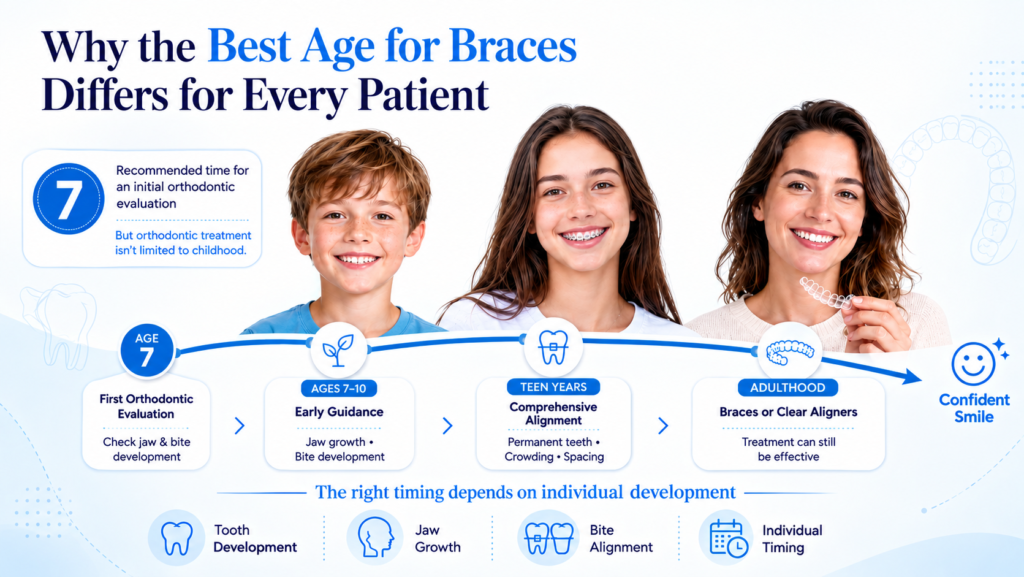
The ideal age for braces varies, but Your Healthy Smile Dentists recommend an evaluation by age 7 to plan more effectively. Doing it by that age helps to map out a timeline that aligns with natural facial growth and dental structure. However,crossing that age doesn’t mean braces are out of reach for you. In this article, we find out why, and understand its role in determining the best age for braces.
Definitions and Diagnosis
To properly manage orthodontic progression, it is essential to understand the underlying skeletal and dental stages.
1. Early Childhood Guidance or Interceptive Orthodontics
This early window allows us to see how the teeth and jaw are developing.
- Early interceptive treatment typically focuses on children between the ages of 7 and 10.
- Ideally, a professional evaluation by age 7 allows us to map out a timeline that aligns with the child’s facial development.
- This stage addresses severe structural anomalies such as severe underbites, pronounced crossbites, and extremely narrow upper palates.
Your Healthy Smile Dentists utilise specialised tools during this window to gently guide bone growth before the facial structures fuse.
2. Adolescent or Comprehensive Orthodontics
Comprehensive alignment is a complete therapeutic phase targeting fully erupted permanent teeth.
- The standard treatment is often delayed until the early teenage years if the jaw alignment of a child is already well-proportioned.
- The main focus changes from guiding jaw growth to moving the tooth root through the bone normally
- This treatment pathway remains highly effective during adulthood, provided that the gums and bone structures remain healthy.
You can learn more about comprehensive dental checkups on our website.
So, why does the best age for braces differ for every patient?
Because children lose primary teeth and grow adult teeth at different rates, the ideal age for braces naturally varies from person to person. It also differs becauseevery child grows on a unique biological makeup and clock. This is why the treatment must be timed to match the jaw development and specific structural needs.
Comparing Timelines for Availing Braces
The table below shows the key differences between these options based on observations by Your Healthy Smile Dentists at St Clair.
| Factor | Early Treatment (Ages 7–10) | Adolescent & Adult Treatment |
| Primary Goal | Guides jaw growth and corrects developing bite issues | Aligns permanent teeth and refines the bite |
| Jaw Growth | Takes advantage of active facial growth | Works with fully developed jaw structures |
| Best For | Crossbites, underbites, narrow upper jaws and significant jaw concerns | Crowding, spacing, crooked teeth and established bite concerns |
| Treatment Approach | Growth-guiding appliances and interceptive orthodontics | Braces or clear aligners for tooth movement |
| Oral Hygiene | Requires parental support with brushing and appliance care | Relies on the patient’s consistent oral hygiene and compliance |
Clear Aligners or Invisalign for Adults
Once the jaw stops developing, adult patients often focus on keeping their normal appearance and lifestyle. This is when the further steps depend on dental health and motivation:
- Treatment can successfully fix teeth alignment at any stage of adulthood if the gums and bones are healthy.
- Clear aligners, like Invisalign, let adults improve their smile without changing how they look.
- Removable trays are very convenient, making it easy to take them out to eat, brush, and floss.
Simply, as long as your gums and bone structures remain healthy, you can successfully start treatment at any stage of adulthood.
Costs and Financial Planning
We understand that the overall cost of braces is important for budgeting.
There is no universal price tag because the orthodontist cost for braces depends on how complex the alignment is and how long the treatment needs to last.
- Difficulty and time of the treatment: The total cost depends on how complex the misalignment is and how long the treatment lasts.
- The type of braces affects the cost: Choosing invisible braces means higher starting costs because of custom laboratory work and advanced 3D imaging.
- Monthly payments make it easier: Flexible monthly payment plans can be utilised to spread the cost over the treatment time.
If you already have Invisalign and are looking for your family member, checking our Invisalign family option can be helpful.
Ready to Schedule a Consultation?
As with any treatment, the outcome depends on individual biological factors and structural needs. As such, there cannot be a uniform answer to questions regarding treatments and the most appropriate age for braces.
By studying the developments we discussed, our St Clair orthodontic team ensures that safe and suitable care is delivered to you, regardless of age.
By calling (02) 9670 6991, we can help you choose the most suitable and comfortable dental appliance for you.
Also, with Your Healthy Smile Dentists at 154 Bennett Rd, St. Clair, you also benefit from comprehensive support and aftercare required for braces or Invisalign in St Clair.
FAQs
1. Can a patient receive braces if they have dental crowns or missing teeth?
Yes, individuals with crowns, bridges, or missing teeth can still undergo alignment. The appliance moves the root structure through the bone normally, and missing gaps can be managed or closed during the process.
2. What factors determine the overall orthodontist cost for braces?
The total expense depends on the complexity of the structural misalignment, the type of appliance selected, and the expected duration of the treatment plan.
3. Why does the invisible braces cost differ from traditional metal appliances?
Clear options often require custom laboratory manufacturing, advanced three-dimensional imaging, and specialised clear materials, which impacts the initial production costs.
4. How often do patients need to attend adjustment appointments?
For braces, adjustments are typically scheduled every four to eight weeks. These short visits allow the dentist to replace wires, adjust tension, and monitor individual progress.
5. What is the average duration for comprehensive teeth straightening?
Most comprehensive treatments last between twelve and thirty months. The exact timeframe relies on the severity of the misalignment and how closely instructions are followed. Learn more by asking Your Healthy Smile Dentists.
6. Do habits like thumb sucking impact early childhood development?
Prolonged thumb sucking applies continuous pressure to the upper jaw and front teeth, potentially causing an open bite or a protruding jaw shape that requires early intervention.
Reviewed By Dr. Lekha Menon

Dr Lekha Menon
Dr. Lekha Menon is the Principal Dentist at Your Healthy Smile. She graduated from dental school in 1998 and has over 25 years of experience, serving the St Clair community since 2007. She provides personalised dental care with expertise in general and cosmetic dentistry, Invisalign®, orthodontics, dental implants, crowns, veneers, dentures, and root canal therapy.