
Tooth decay is perceived as a childhood concern, but data reveals that adults are experiencing cavities at increasingly high rates as well. The reasons for this trend are tied to biological changes, modern lifestyle habits, and medical factors that specifically manifest later in life.
In this article, Your Healthy Smile Dentists help you learn more about Tooth Decay in adults and other age groups while considering various other factors as well.
A Quick Look at What Causes Tooth Decay in Adults
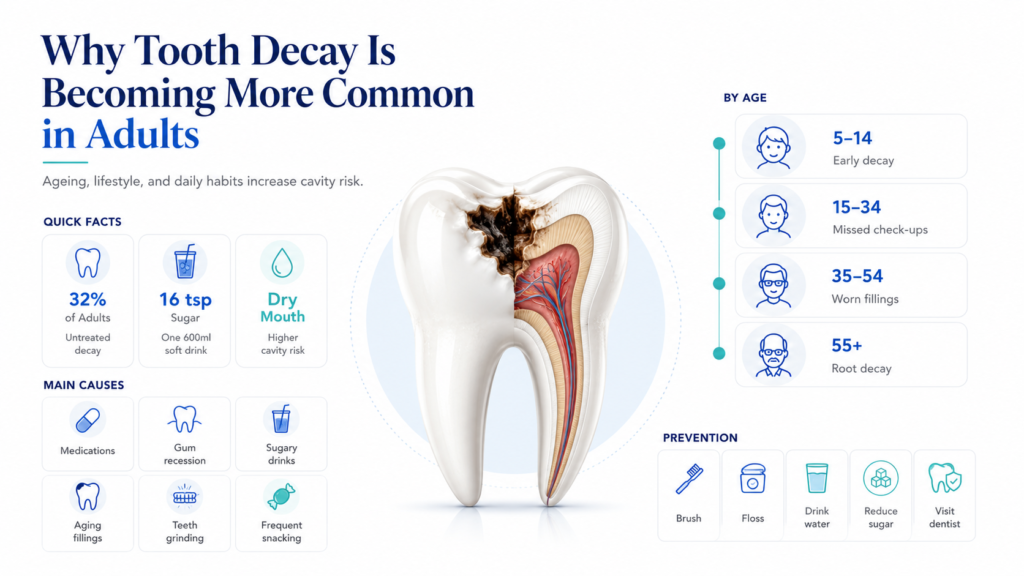
- A standard 600ml soft drink contains roughly 16 teaspoons of sugar. This intake exceeds the World Health Organisation’s maximum daily limit of 6 teaspoons. This contributes directly and positively to tooth decay in adults.
- With water fluoridation, tooth retention is achieved. While this is a major medical achievement for us all, it creates a unique aging challenge wherein as gums naturally recede, the softer dentine of the root surface is exposed and decays more rapidly than the crown enamel.
- Not everyone brushes their teeth regularly. As shocking it might sound, the issue is compounded by a lack of regular preventive dental care. Not limited to just general issues, preventive dentistry can also help you detect oral cancer.
- Unsurprisingly, while cities benefit from excellent dental infrastructure and consistent water fluoridation, regional and remote communities face severe disadvantages.
Why the Rise of Tooth Decay in Adults
Data from the Australian Institute of Health and Welfare (AIHW) reveals that tooth decay remains the most common chronic disease in Australia. It is found that approximately 32% of Australian adults have at least one tooth with untreated dental decay.
1. Medication-Induced Dry Mouth
Many adults regularly take prescriptions for high blood pressure, cholesterol, anxiety or allergies. A highly prevalent side effect of these medications is dry mouth, clinically termed xerostomia.
Saliva is the primary natural defence system of the mouth, i.e., it washes away food debris, buffers harmful acids, and supplies essential minerals to repair our enamel. When saliva production drops, bacteria multiply rapidly, creating an ideal environment for decay.
2. Gum Recession & Root Cavities
With age or long-term firm brushing, gums often begin to recede. This process exposes the roots of our teeth.
Unlike the upper crown of a tooth (shielded by highly resilient enamel), the root surface is made of dentine. Dentine is softer, less mineralised, and far more susceptible to rapid acid erosion.
3. Breakdown of Existing Dental Work
Dental restorations are highly durable, but they do not last indefinitely.
Fillings, crowns, and bridges undergo immense pressure over the years too. Eventually, micro-gaps or structural cracks develop and bacteria accumulate in them.
It leads to recurrent decay that is often difficult to detect without professional dental imaging.
4. Constant Grazing & Beverage Sipping
Did you know? Every time food or drink is consumed, carbs are converted into acids, initiating an enamel demineralisation.
Add to that, our schedules and routines frequently promote continuous snacking and coffee, tea, or sports drinks.
Ultimately, teeth remain exposed to a continuous acid secretion,preventing remineralisation.
5. Chronic Stress & Bruxism
Elevated stress levels prompt many adults to unconsciously clench or grind their teeth, a behaviour known as bruxism.
This chronic mechanical stress can cause micro-fractures in the protective enamel layer.
What’s the ultimate outcome of these structural compromises? These create perfect channels for bacteria to penetrate deeper into our tooth structure.
However, it is relieving to know that this progression isn’t instantaneous.
🦷 Your Healthy Smile Dentists have discussed the 5 stages of tooth decay and how to treat each one effectively.
Tooth Decay Trends Across Age Groups
The impact of tooth decay is neither limited to adults nor uniform across the age groups.
Our 4 decades of experience reveals that tooth decay trends are divided into these age brackets:
1. Children and Teenagers (Ages 5 to 14)
Children 5 to 10 years old have at least one primary baby tooth with untreated decay. As permanent teeth emerge, some experience untreated decay in their adult teeth.
2. Young Adults (Ages 15 to 34)
This generation benefits from fluoridated water since birth, yet often shows a laid-back approach and outright avoidance of periodic dental check up and clean visits.
3. Middle-Aged Adults (Ages 35 to 54)
Fillings and crowns placed during adolescence or early adulthood begin to age, fracture, or wear down, creating micro-gaps where bacteria accumulate. Also, chronic stress-induced teeth grinding and high coffee consumption only add to the issues..
4. Older Australians (Ages 55 and Above)
This group has the highest cumulative tooth loss, missing an average of 13 teeth per person. We mentioned earlier how the ageing gums cause this when paired with prescription medications.
Get Optimum Oral Health Care for Your Entire Family
The nature of tooth decay transforms entirely as we age. Understanding it comprehensively makes it clear that maintaining adult oral health requires a shift in focus from basic brushing to targeting systemic factors such as dry mouth, structural wear, and dietary frequency.
The good news is that Your Healthy Smile Dentists in St Clair offer a targeted approach for each member of your family. We offer a wide range of dental services that look beyond tooth decay in adults.
If you are looking for the best dentist near me, find us at 154 Bennett Rd, St. Clair for a dedicated consultation through (02) 9670 6991.
FAQs
1. What does early stage tooth decay look like in adult teeth?
Early decay often manifests as chalky white spots on the enamel surface. This indicates a loss of minerals. At this stage, there is no physical hole in the tooth, and a person will generally feel no pain. If the process continues, the spot turns brown or black before structural collapse occurs.
2. Can adult cavity damage be reversed without a filling?
Yes, but only in the very early stage before the enamel breaks down to form a permanent cavity. This reversal process is called remineralisation. It requires plaque removal, reduced dietary sugar intake, and the application of topical fluoride or mineral pastes to rebuild the weakened crystalline structure.
3. How does elevated daily stress lead to tooth decay?
Chronic stress triggers the nervous system to reduce saliva production, creating a drier mouth environment where destructive bacteria thrive. It also drives unconscious habits, such as teeth grinding, which can cause micro-cracks in enamel, and poor dietary choices, such as increased snacking on sugary foods.
4. Why do pregnant individuals often experience a spike in cavities?
Pregnancy causes hormonal fluctuations that alter saliva composition and increase the inflammatory response of the gums. Additionally, frequent morning sickness exposes teeth to harmful stomach acids, while changes in dietary cravings can lead to more frequent carb intake.
5. What are the signs that a cavity has reached the dental nerve?
When decay penetrates deep into the inner pulp, where the nerve resides, a person typically experiences sharp or throbbing pain. Other symptoms include lingering sensitivity to hot or cold temperatures, pain when biting down, facial swelling, or a persistent bad taste in the mouth.
6. Does charcoal toothpaste protect enamel or cause more decay?
Many charcoal toothpastes are highly abrasive and also lack fluoride. While they may remove surface stains initially, they can wear down the thin layer of protective enamel over time. This combination leaves teeth more vulnerable to decay.
Reviewed By Dr. Lekha Menon