
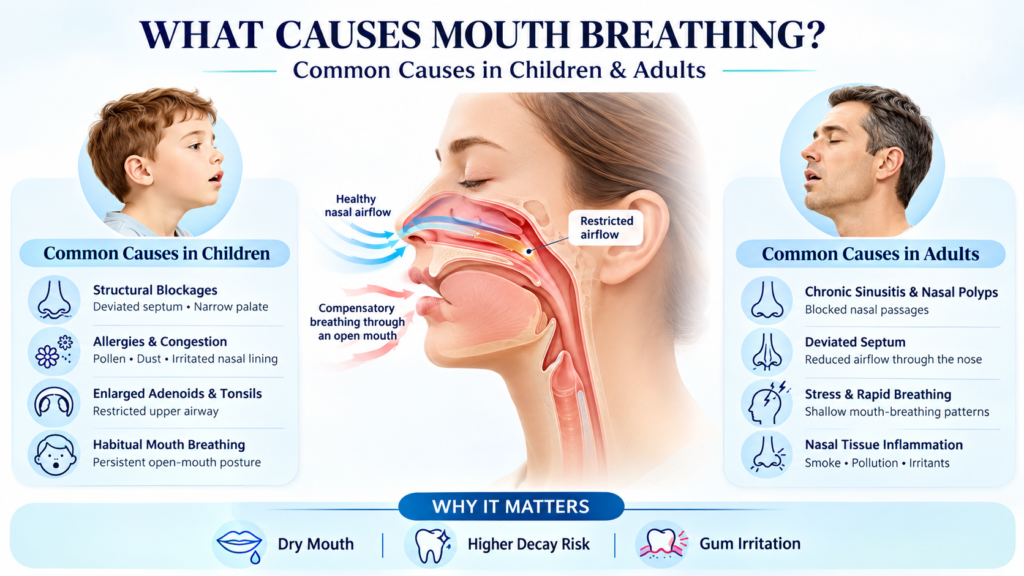
Mouth breathing occurs when nasal passages are partially or completely blocked, forcing the body to rely on the oral cavity for oxygen intake.
And while occasional mouth breathing can occur for most during intense physical exertion or a short illness, persistent mouth breathing stems from specific physical, structural, or environmental factors.
This is particularly important as this airway path also plays a crucial role in shaping your oral health, jaw development, and overall systemic well-being.
Understanding the Physiology of Mouth Breathing
Our nasal passages warm, humidify, and filter ambient air prior to pulmonary intake.
Bypassing this natural filtering mechanism deprives the respiratory system of these built-in biological protections.
As a result, unconditioned air enters and disturbs the delicate microbiome and surrounding soft tissues.
Common Causes of Mouth Breathing in Children
Mouth breathing occurs primarily when obstacles restrict normal airflow through the nasal passages. These obstacles can be anatomical or inflammatory.
1. Structural Nasal Blockages
Your Healthy Smile Dentists find that anatomic issues such as a deviated nasal septum, narrow dental palate, or enlarged nasal turbinates (structures inside the nose that warm and humidify air) can impede airflow.
This cause can be seen at birth or following facial trauma.
2. Allergic Rhinitis and Chronic Congestion
We also witness how environmental allergies to pollen, dust mites, or animal dander trigger swelling in the nasal lining of a patient. Persistent inflammation makes breathing through the nose difficult, causing children to adapt by opening their mouths.
These occur with seasonal changes or from the moment of first contact itself.
3. Enlarged Adenoids and Tonsils
In Australia, swollen or oversized lymph tissue at the back of the nasal cavity (adenoids) or throat (tonsils) is one of the leading causes of chronic mouth breathing in young individuals.
When this tissue expands, an individual might experience restricted airflow through the upper airway.
4. Habitual Breathing Patterns
Even after an infection clears or enlarged adenoids are treated, some children maintain mouth breathing out of habit.
This is where the muscle memory in the face and jaw can sometimes cause the mouth to stay open during sleep or daytime activities.
Worried about a sudden, erratic breathing pattern of your little one?
Common Causes of Mouth Breathing in Adults
1. Chronic Sinusitis and Nasal Polyps
Long-term sinus infections or non-cancerous growths (nasal polyps) inside the nasal passages are some of the leading causes of mouth breathing in adults.
They create physical barriers that block normal nasal respiration.
2. Deviated Septum and Structural Deformities
In adults, a shifted cartilage wall between the nostrils (deviated septum) frequently stems from past physical injuries, sports trauma, or natural growth patterns.
This narrowing restricts airflow on one or both sides of the nose.
3. Stress and Chronic Hyperventilation
Adults experiencing persistent stress frequently shift to rapid, shallow mouth breathing rather than slow, deep diaphragmatic nasal breathing.
At our St Clair dental clinic, we often discuss how high stress levels and anxiety alter breathing mechanics.
4. Tissue Inflammation and Vasomotor Rhinitis
Environmental irritants such as cigarette smoke, pollution, or the overuse of OTC nasal decongestants are common culprits here.
These can cause chronic swelling of nasal tissues, leading to continuous mouth breathing.
Need emergency dental care?
Immediate Impact of Mouth Breathing in Children and Adults
It is important to know that our saliva serves as an essential natural buffer that washes away food remnants, neutralises bacterial acids, and remineralises tooth enamel.
A major consequence of open mouth posture is xerostomia. Xerostomia is persistent dry mouth caused by reduced saliva flow.
Without adequate lubrication, our teeth can become highly vulnerable to dental caries and gum tissue inflammation.
Long-Term Impacts of Mouth Breathing in Children and Adults
Persistent open mouth posture alters the natural balance of facial muscles and jaw mechanics over time.
It can also lead to long-term impacts like:
-
- Accelerated plaque accumulation and increased risk of marginal gingivitis.
-
- Changes in the oral microbiome leading to persistent halitosis and mucosal tenderness.
-
- Increased susceptibility to tooth enamel erosion and root decay.
This is the reason focusing on early detection prevents the structural shifts.
Treat Mouth Breathing Issues For Your Family
Managing chronic airway challenges requires an empathetic and collaborative clinical approach. At our St Clair dental clinic, we help you receive all that.
With Your Healthy Smile Dentists, preventive care is possible at our St Clair dental clinic.
If you need detailed evaluations and care for your mouth breathing issues, call (02) 9670 6991.
FAQs
1. Does mouth breathing alter facial growth in children?
Yes, persistent oral breathing during childhood can influence craniofacial development. When a child continuously keeps their mouth open, the tongue sits low rather than supporting the roof of the mouth. Over time, this can lead to an elongated facial structure, a narrow upper jaw, a receding chin posture, and crowded teeth.
2. Can mouth breathing cause permanent harm?
Continuous mouth breathing dries out protective saliva. Saliva is crucial for neutralising plaque acids, clearing food debris, and remineralising enamel. Reduced saliva levels increase susceptibility to tooth decay, enamel erosion, persistent halitosis, and early stage gum disease.
3. Can mouth breathing cause obstructive sleep apnoea?
Mouth breathing is closely associated with obstructive sleep apnoea. An open mouth resting posture allows the jaw and tongue to fall backward towards the throat, narrowing the upper airway and increasing the risk of airway collapse during sleep.
4. Does mouth breathing lead to bad breath?
Yes, mouth breathing evaporates saliva, creating a desiccated environment inside the oral cavity. Without adequate saliva to wash away organic debris and control microbial growth, odour producing bacteria multiply rapidly, causing persistent bad breath.
5. Can mouth breathing affect my oxygen intake?
Nasal breathing facilitates the release of nitric oxide, a compound that expands blood vessels and enhances oxygen absorption in the lungs. Bypassing the nose reduces nitric oxide uptake, which can lower oxygen delivery efficiency to tissues during sleep.
Reviewed By Dr. Lekha Menon

Dr. Lekha Menon
Dr. Lekha Menon is the Principal Dentist at Your Healthy Smile. She graduated from dental school in 1998 and has over 25 years of experience, serving the St Clair community since 2007. She provides personalised dental care with expertise in general and cosmetic dentistry, Invisalign®, orthodontics, dental implants, crowns, veneers, dentures, and root canal therapy.