
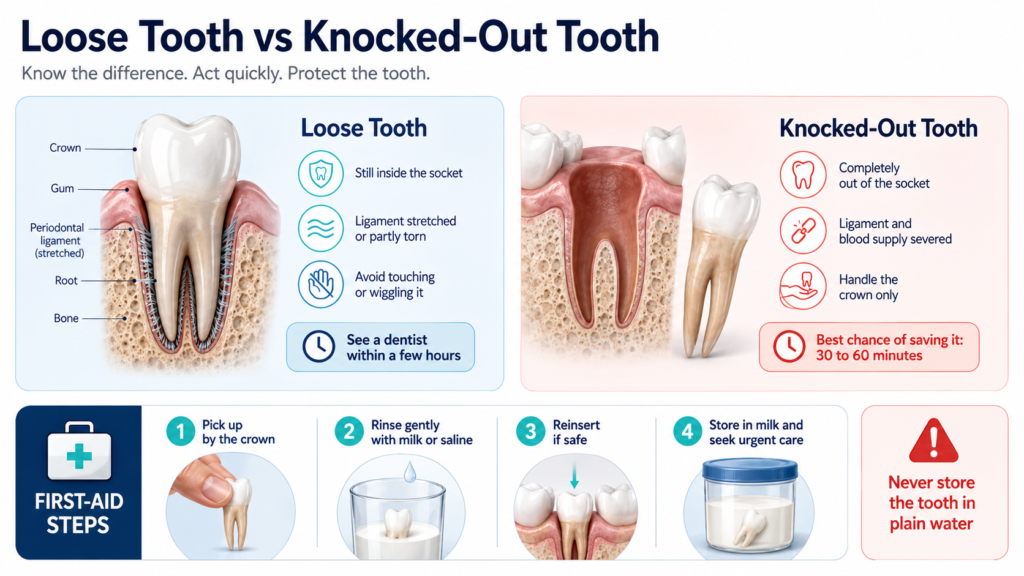
When dental trauma occurs, your response can mean the difference between saving and losing a tooth. A loose tooth and a knocked-out tooth represent different levels of dental trauma. In one, the tooth is still intact in its location; in the latter, it is completely missing.
To understand the appropriate response and the difference between a loose tooth vs knocked out tooth, it is necessary to examine what happens beneath the gumline during the injury.
Definitions and Diagnosis
To properly manage dental trauma, it is essential to understand the underlying damage.
Subluxation and Luxation: The Loose Tooth
Our teeth are anchored by a complex system of tissue fibres.
- A loose tooth means that these tissue fibres, known as the periodontal ligament, have been stretched or partially torn.
- The blood vessels and nerves inside the tooth pulp may bruise, but the tooth remains physically located in the bony socket.
This is where a professional inspection can help, and one must avoid touching or wiggling the tooth.
Avulsion: The Knocked Out Tooth
A completely knocked out tooth is a severe dental emergency, clinically termed a dental avulsion.
- This is where the tooth is entirely detached from the dental socket.
- If we look deeper, the periodontal ligament fibres are severed, and the blood supply and nerve pathways are fully cut off.
In this case, emergency intervention or knocked out tooth treatment is mandatory to give the tooth a chance to survive.
Timelines and Comparison
When it comes to either a loose tooth vs knocked out tooth, managing facial trauma requires strict adherence to timelines.
The table below highlights the differences between these conditions based on decades of observation by Your Healthy Smile Dentists at St Clair.
| Diagnostic Factor | Loose Tooth | Knocked Out Tooth |
| Socket Position | Remains inside the dental socket | Completely displaced from the socket |
| Tissue Connection | Periodontal ligament is stretched or partially torn | Periodontal ligament is completely severed |
| Critical Window | Dental assessment within a few hours is recommended | Replantation offers the best outcome within 30 to 60 minutes |
| Handling Rule | Avoid touching, pushing or wiggling the tooth | Hold the tooth by the crown only and never touch the root |
Immediate Knocked Out Tooth Treatment and First Aid
In knocked out tooth treatment, the survival of the root cells is critical. This is where proper handling can help preserve the vitality of cells on the root surface.
We find that IDA Guidelines provide clear instructions for immediate first aid for knocked out tooth treatment:
- Handle by the crown only: Pick up the tooth by the smooth chewing surface. Never touch the root surface, as this will compromise the delicate periodontal cells necessary for reattachment.
- Clean gently without friction: If the tooth is dirty, rinse it briefly under sterile saline or cold milk. Do not scrub, scrape, or use chemical cleaners or tap water.
- Attempt immediate reinsertion: If the individual is conscious, gently place the tooth back into the socket. Hold it in place by biting down lightly on a clean piece of cloth or gauze.
- Store in proper media: If reinsertion is impossible, place the tooth in a small container of cold milk or saliva. Never store the tooth in plain water, as it can cause the root cells to burst.
- Seek urgent dental intervention: Contact emergency services immediately to initiate treatment for a knocked out tooth and stabilisation.
Need emergency consultation? Your Healthy Smile Dentists find that delayed knocked out tooth treatment might result in long term complications such as bone loss or root resorption.
Restoring Aesthetics with Cosmetic Dentistry
Once the initial trauma is stabilised and the surrounding tissues have healed, attention often shifts to restoring the visual appeal and functional integrity of the smile by our St Clair orthodontic.
Why the need for cosmetic procedures in some cases?
- The trauma might leave behind discolouration, minor chips, or even permanent gaps.
- Depending on severity and other factors, treatments such as porcelain veneers, composite bonding, or dental implants can replicate natural tooth structures.
These aesthetic solutions go beyond visual benefits, they can be helpful to regain functionality for an individual.
Long-Term Alignment and Orthodontic Care
According to ADA, checking for subtle structural or alignment variations below the gumline is crucial for long-term health.
Severe dental impacts can shift adjacent teeth, alter your bite mechanics, or disrupt correct jaw development.
This is where Your Healthy Smile Dentists find monitoring the spatial alignment is a vital aspect during the rehabilitation stage.
How can professional guidance help?
Managing dental injuries requires an experienced, multidisciplinary team to handle everything from urgent intervention to long-term care.
We can help you with detailed inspection and long-term alignment strategies like clear aligners (Invisalign).
If you experience a tooth feeling loose, you can book a preventive consultation with Your Healthy Smile Dentists at 154, Bennett Road, St Clair. To find your way to us quickly, you can use the Maps or call us at (02) 9670 6991.
FAQs
1. What is the difference between a loose and knocked out tooth?
The main distinction between a loose tooth vs knocked out tooth is whether the tooth remains in the dental socket. A loose tooth is partially detached but stays within the gums, while a knocked out tooth is completely separated from the mouth.
2. What should I do immediately if a tooth is knocked out?
Immediate treatment involves picking up the tooth by the chewing surface, rinsing it with milk, and gently placing it back into the socket.
3. Can I store a knocked out tooth in tap water?
No, you should never store a displaced tooth in tap water, as its chemical composition can cause the delicate root cells to swell and burst.
4. Is a root canal always needed after replanting a tooth?
Yes, root canal therapy is almost always necessary for permanent adult teeth after an avulsion injury. Because the original blood vessels are completely severed, the internal nerve tissue cannot recover on its own.
5. What can I eat while my loose tooth is healing?
You must maintain a strict soft-food diet for at least 2 weeks, avoiding crunchy or hard foods entirely. Ensure all chewing is directed to the unaffected side of the mouth to prevent putting pressure on the healing ligaments.
6. Does private health insurance cover emergency dental trauma?
Coverage depends on your private health fund’s specific extras policy tier. Major trauma interventions, such as emergency splinting and root canals, are typically classified under general or major dental categories. Find more on this here.
7. When is it time to consider an orthodontic near me?
For cases involving both loose tooth or tooth loss, it is best to get it examined by a dentist to determine the underlying cause.
Reviewed By Dr. Lekha Menon