
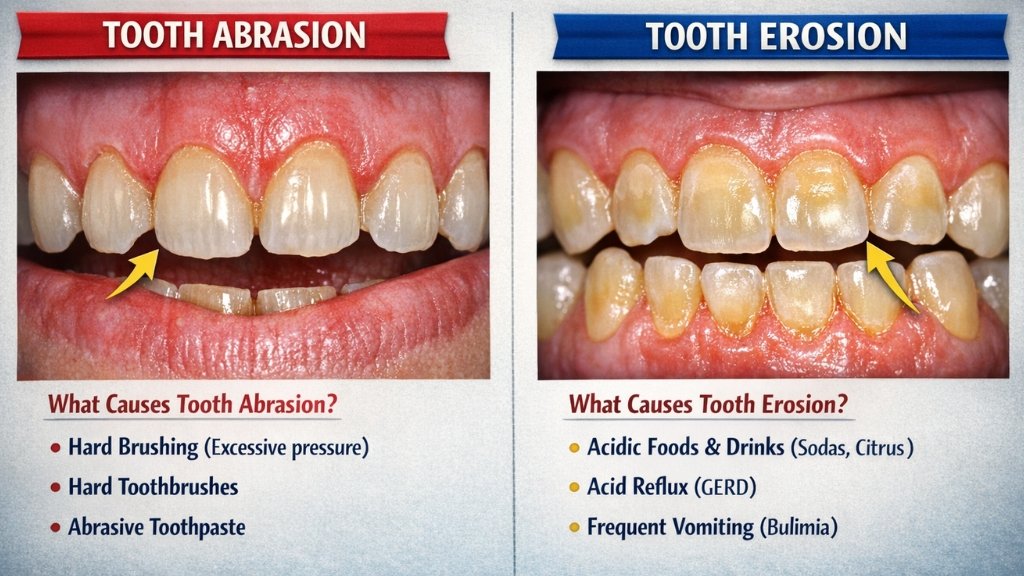
When comparing tooth abrasion vs tooth erosion, we learn that both lead to increased tooth sensitivity due to exposed sensitive dentin. And while both result in thinner and more sensitive teeth, tooth abrasion and tooth enamel erosion are caused by two completely different processes. One occurs due to friction from an external object, and the other occurs when the tooth surface is dissolved by acid.
Understanding the Two Terms
Abrasion is the loss of tooth structure caused by friction from an outside object. It is essentially sanding down your teeth through repetitive physical contact.
Common causes of tooth abrasion include:
- Over-brushing and Abrasive Toothpaste: Using a hard-bristled toothbrush or applying too much pressure while brushing is counterproductive. Also, some whitening toothpastes contain grit that can wear down enamel over time.
- Oral Habits: Biting your fingernails, chewing on pens, or holding metal objects (like hairpins or nails) between your teeth.
- Partial Dentures: Ill-fitting dental appliances that rub against natural teeth.
On the other hand, erosion of tooth is where no bacteria or physical friction is required as a causative agent. The acid here simply softens and washes away the mineralised enamel.
Common causes of tooth erosion include:
- Dietary Acids: Frequent consumption of carbonated sodas (even diet ones), citrus fruits, fruit juices, and sports drinks.
- Stomach Acid: Chronic acid reflux (GERD) or frequent vomiting (associated with morning sickness or eating disorders) is known to expose your teeth to highly corrosive gastric acid.
- Dry Mouth: Saliva helps neutralise acid. Without enough of it, teeth are more vulnerable to chemical wear.
Tooth Abrasion vs Tooth Erosion: Spotting the Difference
Identifying whether you are suffering from erosion of tooth surfaces or mechanical abrasion is vital for treatment. The table below can help you locate and identify tooth erosion and tooth abrasion signs.
| Aspect | Tooth Abrasion | Tooth Erosion |
| Mechanism | Mechanical friction | Chemical dissolution |
| Location | Usually near the gum line | Biting surfaces and inner surfaces |
| Shape | Sharp, V-shaped notches | Broad, shallow, rounded hollows |
| Surface | Smooth and hard | Silky, matte, or translucent |
Understanding tooth abrasion vs tooth erosion allows you to seek remedies involving brushing technique or diet change. But to get a comprehensive picture of tooth wear, we also need to look at the ‘Big Four’.
What Causes Tooth Wear?
While we have learnt about tooth abrasion vs tooth erosion, they are rarely the only culprits. It is because most dental wear is multifactorial, i.e., several things are happening at once. These are the four additional factors that lead to tooth enamel erosion and tooth abrasion.
1. Attrition and Abfraction
To understand tooth wear comprehensively, we also have to account for the following two.
a. Attrition (Tooth-on-Tooth): This is wear caused by teeth grinding or clenching against each other.
- Cause: Most commonly, Bruxism (teeth grinding/jaw clenching).
- Appearance: Flat, polished wear facets on the biting surfaces. Over time, it can make teeth look shorter.
b. Abfraction (Stress-Induced): This is wear at the gum line caused by the tooth flexing under heavy pressure.
- Cause: A misaligned bite or heavy grinding causes the tooth to bend slightly, which makes the enamel micro-fracture right at the neck of the tooth.
- Appearance: Deep, wedge-shaped notches that look very similar to abrasion but are often caused by internal stress rather than external scrubbing.
2. pH Balance and the Vicious Cycle
Your enamel demineralises when exposed to an unfavourable environment.
- Anything you eat or drink with a pH lower than 5.5 (like most sodas, which sit around 2.5 to 3.0) begins to dissolve the mineral structure.
- Erosion softens the enamel, making it much easier for abrasion or attrition to wipe it away. This is why people who drink a lot of sparkling water and brush aggressively see their teeth disappear much faster.
3. The Role of Saliva
Saliva is your mouth’s natural defence system. Beyond helping with the ingestion and digestion of food, it contains calcium, phosphate, and fluoride to repair the demineralised enamel.
If your mouth is dry due to mouth breathing, stress, or certain medications, you lose this protection. And without saliva to neutralise acid, erosion accelerates rapidly. This is when a consultation to discuss dry mouth (Xerostomia) is important.
4. Lack of Prevention Strategies
When you want to move beyond the basics, it is important to consider certain helpful habits.
- The alkaline rinse: If you can’t brush after an acidic meal, rinse your mouth with plain water or, even better, a bit of milk. Milk is alkaline and contains calcium, which helps neutralise the acid immediately.
- Check the RDA of your toothpaste: Many charcoal or extra-whitening toothpastes have high RDA or Relative Dentin Abrasivity scores over 150. These can accelerate the abrasion. As a preventive measure, you can consider toothpastes with an RDA under 100.
- Straw usage: If you must drink acidic beverages (like coffee or lemon water), using a straw positioned toward the back of the mouth minimises contact with the teeth.
- Nightguards: If you suspect attrition, a custom night guard is the only way to physically prevent your teeth from grinding each other down while you sleep.
It is clear that protecting your teeth involves shielding your enamel from friction, acid, and sugar. By understanding the triggers of tooth enamel erosion and tooth abrasion, you can have healthy teeth.
Your Healthy Smiles Dentists believe in a holistic approach. That is why at our clinic at 154 Bennett Road, St Clair, we can help you address the causes of tooth abrasion and tooth erosion effectively. Book your appointment to get the right treatment at the right time.
FAQs
Q1. Is tooth enamel loss reversible?
Enamel does not have living cells, so it cannot regrow, but specialised toothpastes can help remineralise the very outer surface and fill the microscopic gaps. This helps reduce tooth sensitivity.
Q2. How can I tell the difference between a cavity and abrasion?
A cavity is usually a dark spot or a hole caused by bacteria and sugar. Abrasion typically appears as a clean, shiny, V-shaped notch near the gum line, often spanning multiple teeth.
Q3. What is the ‘Critical pH’ I keep hearing about?
The critical pH for tooth enamel is 5.5. When the environment in your mouth stays below this level (more acidic), your enamel begins to dissolve. Most sodas have a pH between 2.5 and 3.5.
Q4. Can electric toothbrushes cause tooth abrasion?
Only if used incorrectly. High-quality electric brushes actually prevent abrasion because they have pressure sensors that stop or flash red if you push too hard. If you scrub with an electric brush like it’s a manual one, you will wear down your enamel.
Q5. Does drinking sparkling water cause tooth enamel erosion?
Yes, but much less than soda. Carbonated water contains carbonic acid (pH ~3–4), which is slightly erosive. The flavoured versions with citric acid are much riskier.
Q6. Is lemon water in the morning bad for my teeth?
Frequent sipping of warm lemon water is one of the leading causes of dietary erosion. If you do it, drink it quickly (don’t sip for an hour) and rinse with plain water immediately afterwards.
Q7. Can chewable vitamins or gummy supplements cause erosion?
Yes. Chewable Vitamin C (ascorbic acid) is highly acidic and one of the tooth erosion causes. If it sticks to your teeth or you chew it daily, it can cause localised erosion. It is advisable to swallow pills with water instead if you have thin enamel.
Reviewed By Dr. Lekha Menon