
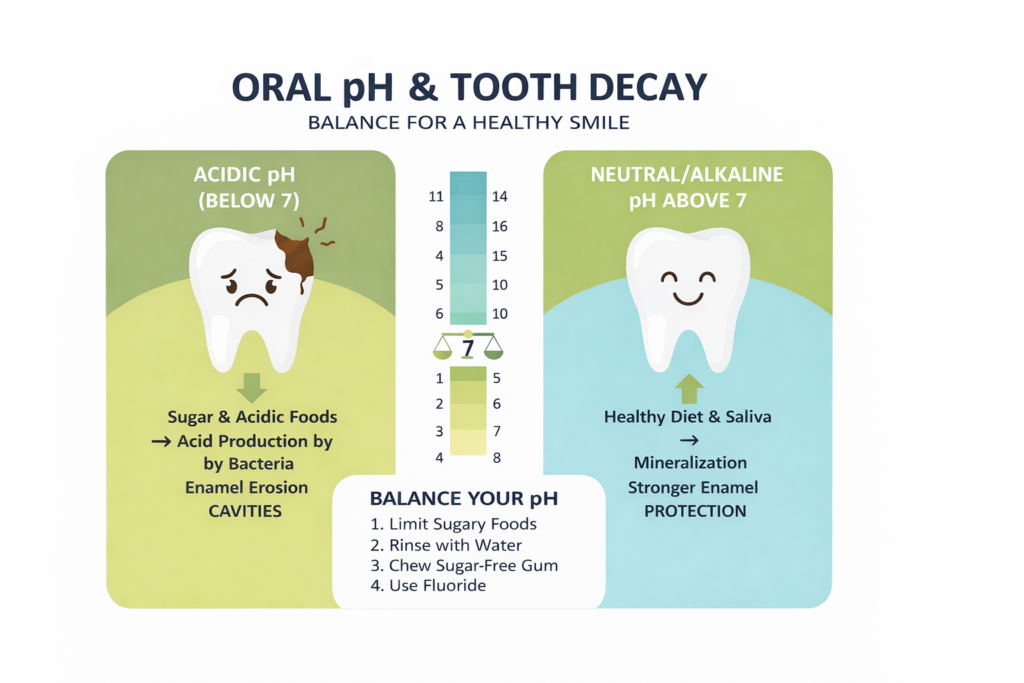
Why do two people with similar brushing habits have very different dental health? The answer often lies in an individual’s oral pH levels.
As your oral pH levels drop too often, tooth decay and weakened enamel push teeth through the early stages of tooth decay. The good news is your own saliva and preventive dentistry measures like fluoride treatments restore balance and prevent cavities from forming.
Let’s understand the science behind it and how you can ensure your mouth’s pH levels are within a safe range.
Why Oral pH Levels Matter For Healthy Teeth
Your mouth’s pH levels measure how acidic or alkaline your mouth is. A healthy mouth usually sits close to neutral, but each time you eat or drink something sugary or acidic, these levels drop.
Why does this matter? Because enamel begins to soften when oral pH levels fall below a critical point. And it is important to note that repeated drops create the perfect environment for decay to begin.
These links between sugar, acid and decay are well documented in NSW health guidance and national data.
How Oral pH Levels Drive the Stages of Tooth Decay
Tooth decay is not sudden. It develops gradually as oral pH levels shift throughout the day. Each stage below shows what is happening inside your mouth, often before you feel any symptoms.
| Oral pH levels (approx. range) | What is happening in your mouth | What you may notice |
| Neutral to slightly alkaline (around 7.0) or Healthy enamel | Saliva neutralises acids and supplies minerals back into enamel. Teeth can repair early damage naturally. | Teeth feel normal with no signs of sensitivity. |
| Mildly acidic levels (around 6.5 to 5.8) point to early demineralisation | Acids from food and drink start pulling minerals out of enamel. Saliva can still reverse this if given time. | Sometimes a chalky or dull look on teeth. |
| Below critical level (around 5.5) point to enamel weakening | Enamel softens faster than it can repair. Acid attacks become more damaging if frequent. | Mild sensitivity to cold or sweet foods may begin. |
| Progressive decay where the pH persistently drops below 5.5 | The enamel surface breaks down permanently. Bacteria penetrate deeper layers. | Sensitivity increases and dark or white spots may begin to appear. |
| Prolonged acidity over time causing cavities and advanced decay | Structural tooth damage occurs. A cavity forms and cannot heal on its own. | Pain, visible holes, and frequent instances of food trapping. |
The Role of Saliva As Your Mouth’s Natural Protector
Saliva is often overlooked, yet it is your strongest defence. It buffers acids, supplies minerals, and restores safe oral pH levels.
However, if you’ve noticed dryness or frequent thirst, it is worth mentioning during your next dental check-up. This is one reason our dentist in St Clair looks beyond teeth alone and assesses overall oral balance.
Did you know? Caused by stress, medications, ageing or dehydration, a dry mouth significantly increases decay risk.
How to Balance the pH Levels of Your Mouth
Balancing oral pH levels does not require drastic changes. Small, consistent habits make the biggest difference. They slow or stop progression through the stages of tooth decay and form the foundation of effective preventive dentistry.
To do so, you may:
- Brush twice daily using fluoride toothpaste to strengthen enamel.
- Limit how often you eat or drink sugary or acidic items, not just how much.
- Drink plain water between meals to support saliva flow.
- Wait at least 30 minutes after acidic foods before brushing.
- Chew sugar-free gum to stimulate saliva.
- Schedule regular dental check-up visits for personalised prevention advice.
When Should You Book a Dental check-up?
Many people wait for pain to aggravate before seeing a dentist. By then, the opportunity for true prevention has often passed. A dental check-up is most effective before symptoms become disruptive or irreversible.
You must look out for hints through the questions below:
- Do you notice short, sharp sensitivity to cold air, chilled drinks or sweet foods, even if it fades quickly?
- Have you seen chalky white spots, surface staining or subtle roughness on your teeth, especially near the gumline?
- Has it been longer than six months since your last dental check-up, even if nothing feels unusual?
Observations like the above can often indicate enamel demineralisation. This is where recurring imbalance begins to disrupt the tooth surface’s mineral structure.
The good news is that at this stage, decay is still non-cavitated, i.e., it has not yet formed a permanent hole and can often be stabilised or reversed.
A Healthier Smile Starts With Balance
Tooth decay is an imbalance in the chemistry of your oral health. When your oral pH levels are balanced, your teeth remain strong; if neglected, tooth decay can develop.
At Your Healthy Smile Dentists, we enhance remineralisation through targeted therapies. This helps you avoid costly surgeries in future.
If you are looking for treatments that support your long-term wellbeing, meet Your Healthy Smile Dentists at 154 Bennett Road, St Clair. We offer preventive dentistry measures that are designed for you.
FAQs
Q1. Can I test my oral pH levels at home?
Home kits can offer insight, but they cannot replace professional assessment of plaque, saliva and decay risk.
Q2. Do children and adults face the same risks of tooth decay?
While risk remains the same, the risk factors differ. Children, busy adults and seniors all benefit from preventive dentistry.
Q3. Is fluoridation important for my dental health?
Indeed. Fluoridation boosts resistance to acid and complements tooth-brushing with fluoride. Professional guidance in Australia supports fluoride use as a key element of preventive dentistry.
Q4. Does drinking water help balance oral pH levels?
Plain water helps dilute acids, supports saliva flow and encourages a faster return to a healthy oral pH balance.
Q5. Are acidic drinks worse for my teeth than sugary foods?
Both can lower oral pH levels. This is because acidic drinks cause immediate erosion, while sugars feed bacteria that produce acid over time.
Q6. Are “healthy” foods bad for oral pH?
Surprisingly yes. Some healthy foods, such as citrus fruits and juices, are acidic and can lower oral pH if consumed frequently.
Reviewed By Dr. Lekha Menon